Speeches
UNGA1_rotator
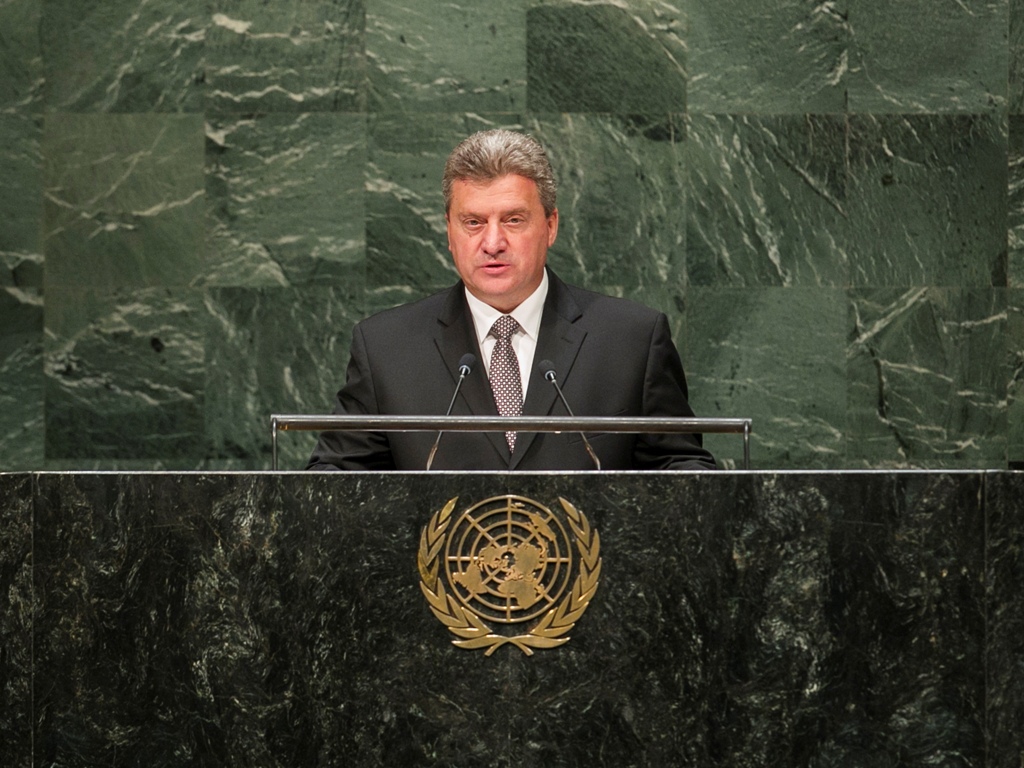
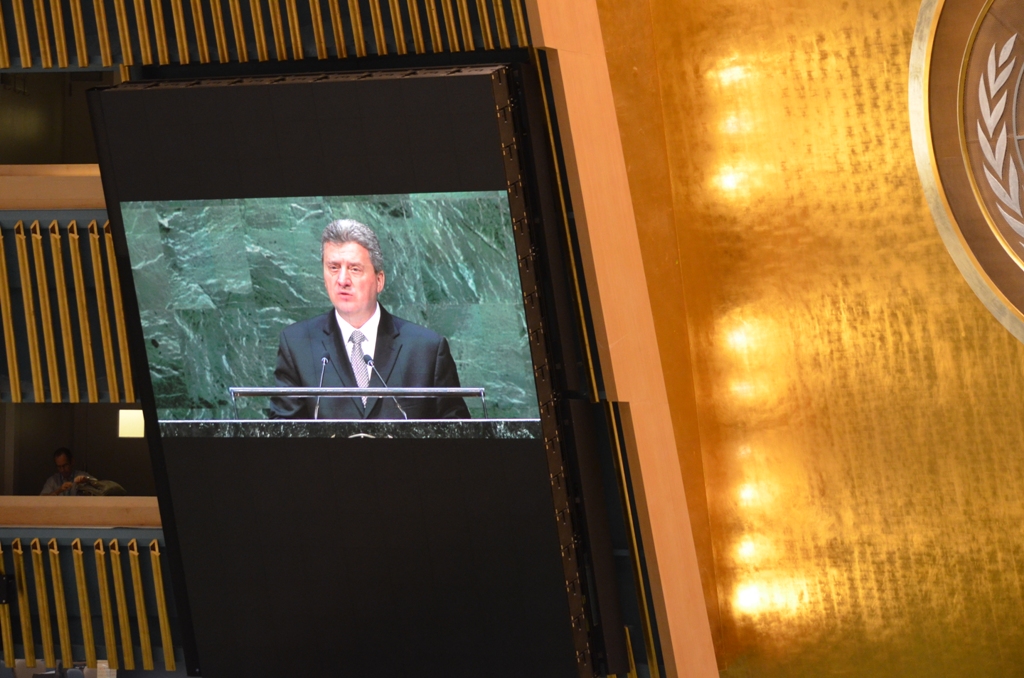
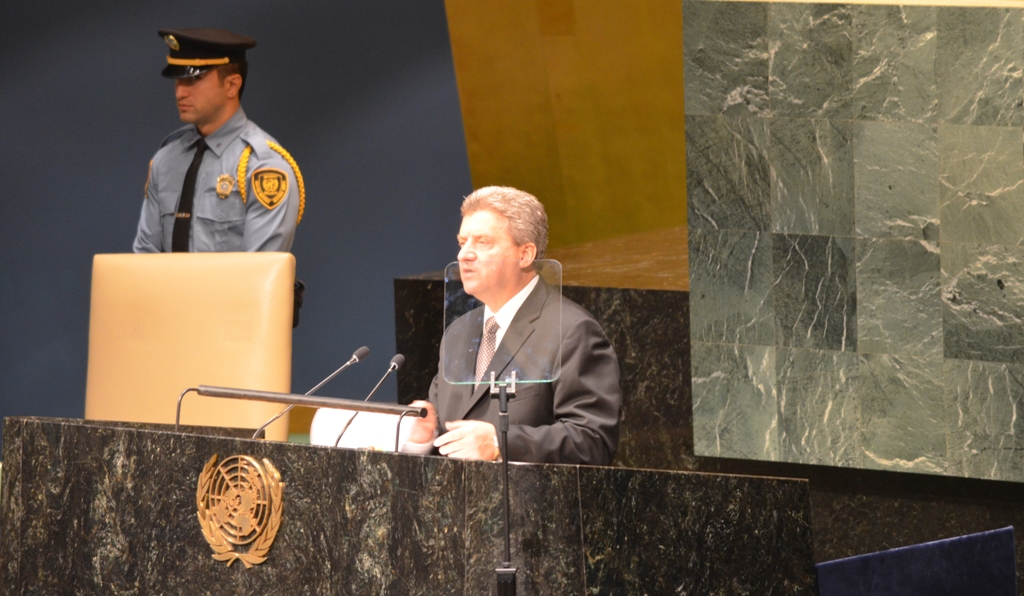
Address by President Ivanov at the 69th Session of the United Nations General Assembly
Friday, 26 September 2014 23:47


UNGA1Honorable Mr. President,

Distinguished Mr. Secretary-General,
Excellencies,
Ladies and Gentlemen,

I am greatly honored to address this outstanding forum and share the views of the Republic of Macedonia on issues of global concern.

In this dynamic, hyper-connected and changing world, one thing remains constant, and that is the need for greater predictability. Predictability on which peace, security and stability depend, but also global welfare and progress.

Mankind is today faced with many challenges, though two challenges request our full attention.

The first one comes from the order of the nature, and the second of the international order. The root of the first challenge is in the human neglect of natural laws. The second challenge arises from the violation of international laws.

Ladies and Gentlemen,

Guided by the idea that "man is the measurement of all things", mankind has made a wrong calculation. We are in a race for progress and new discoveries, which go hand in hand with the race for unequal exploitation of resources. Race in which the only rule is that there are no rules. Everything is possible and everything is allowed, including pollution of the air we breathe, the water we drink and the soil we feed from.

As humankind, we were selfishly focused on immediate wants and needs. We forget that natural resources are given to us in confidence to preserve them for our children.

Opposing nature, we are undermining the foundations of our own future. Our citizens, our states and economies are already starting to pay the price. We are to face a period of extreme weather conditions, when the cities are more likely to be flooded, rivers will dry up, crops will fail, and the price of food will increase. Natural disasters at global level are a loud alarm that climate change is a new reality that is changing our lives and the lives of the future generations. Recently, our region, Southeast Europe, was hit by and reminded of this reality.

The Republic of Macedonia is the first country in our region which has completed the Third National Report under the United Nations Framework Convention on Climate Change. We have already defined the next steps in all key sectors of the economy and society at national and local level for disaster risk reduction and climate change adaptation. We have done this by enforcing strategies and making efforts to reduce greenhouse gas emissions and increase energy efficiency.

We welcome the initiative of the President of the 69th General Assembly, His Excellency Mr. Sam Kutesa, on taking decisive and concrete measures to remedy the two pains of the world: increased global poverty and diminished access to basic resources - pure water, education, health care and clean environment.

Here, at the United Nations, we are all one family. And, as a family, we should help each other in achieving the Millennium Development Goals. But we have to focus on two things: how to reduce global poverty and ensure sustainable development.

Next year, 2015, is a year of great expectations worldwide. Expectations that a real synergy of all major challenges will finally be achieved - climate change adaptation, disaster risk reduction and sustainable development. We expect the post 2015 development agenda to include global, holistic, scientifically-grounded, feasible and legally binding goals as we have to leave a safer world to our descendants.

However, we should be aware that the natural balance is disturbed and many things will not be as before. We will need to learn to live in this changed world.

Esteemed Excellencies,

As the challenge posed by the nature is a result of the human neglect of the natural laws, the challenge of the international order arises from the violation of international law.

I said before that here we are all one family of the United Nations. In every family there are rules of conduct and mutual respect. Families without rules of conduct are known as dysfunctional families.

The Republic of Macedonia is strongly committed to respecting the United Nations Charter, which is one of the primary foundations and principles of the international law.

The rule of law is incomplete and impossible without respect for human rights. As a member of the UN Human Rights Council, the Republic of Macedonia, in continuity and in essence, is committed to protecting and promoting human rights and the right to human dignity in the world. The Republic of Macedonia has achieved the highest standards of respect for human rights and the rights of communities worldwide. This is possible thanks to the Macedonian model of coexistence as a model of integration without assimilation which is not based on tolerance, but on respect for diversity.

It is indeed human rights and human dignity of the Macedonian citizens that are being continually denied by one member of this family and a member of NATO and the European Union.

Identity and language are inseparable parts of our personality, of freedom of expression, of human rights. They are universally accepted principles that no one and never compromise with. The respect for human rights, including the right to self-identification and human dignity, are the highest values of the United Nations. Highest values which are also political criteria for membership of the Republic of Macedonia in the European Union.

Forcing us to give up on the Macedonian identity, the country that is blocking us requires from us the impossible – to breach the fundamental principles of the Union in order to meet the conditions for membership in the Union. It requires that we breach the rule and betray our global family.
UNGA2Dear Friends,

When, in 2008 at the NATO Summit in Bucharest, we refused to change the identity of the Macedonian people as a precondition for the already deserved membership in NATO - we did it on the basis of international law.

When, on November 17, 2008, we launched the proceedings against our southern neighbor to the International Court of Justice - we did it on the basis of international law.

When, on 5 December, 2011, the International Court of Justice ruled that the blockade of the Republic of Macedonia's integration in NATO is illegal, that the undertaken international commitments are violated, it did it on the basis of international law.

When, in a year to a year, we sustain the unprincipled and illegal blockades, we do it because of international law. Because we believe that international law is the only thing that provides predictability and certainty in this world order.

With our example, we demonstrate in principle how other countries should respect international law. Even the International Court of Justice almost unanimously concluded that we acted correctly.

Despite this, the Republic of Macedonia is ready for a mutually acceptable solution within the framework given by the resolutions of the United Nations, the Interim Accord and the Judgment of the International Court of Justice. The issue of identity has never been part of this framework, because identity is neither discussed nor negotiated.

Therefore, I urge the United Nations and the competent authorities to become engaged and devote maximum attention in finding a mutually acceptable solution within the framework of international law.

Ladies and Gentlemen,

Two years ago I was at this same place. I remember well that it was preceded by the high-level meeting on the rule of law at national and international level. The General Assembly debated the Secretary-General's report on the Rule of Law.

Two years have passed and we are still debating. We are still waiting the ruling of the International Court of Justice to be respected.
Our southern neighbor continues, day by day, to violate international law. It continues to violate the resolutions of the United Nations of 1993 and the 1995 Interim Agreement. It still ignores the ruling of the highest legal authority in the world.

The ruling does not apply only to the state that blocks us. The ruling applies Erga Omnes to all member states of the international organizations that still block our membership.

Every blockade in our European and Euro-Atlantic integration undermines the international legal order. By tolerating the blockades, a dangerous precedent is created. A precedent of mutual blocking and blackmailing, motivated by narrow national interests at the expense of the collective interests of the European Union and NATO. Hence, dysfunctional families are created that do not respect the rules of conduct.

Disrespect of the highest legal authorities implies erosion of the culture of respect for international law in the world. The erosion suspends the rule of law and leaves room for anarchy.

For years we pertinently point out that if someone pollutes the spring, then the flow and the watershed will be contaminated as well. If someone questions the basic human rights, the right to human dignity and the right to self-identification, then the rest of international law will be challenged, too. While we were warning that in the case of the Republic of Macedonia international law is violated, rarely anyone listened to us. Today, the price is higher.

Everyone calls upon international law when others are expected to respect it, and ignore it when they themselves must respect it.

We do not want to follow the example of those who break the law as we are aware of the consequences.

If you remove one link, one factor or one participant from an eco-system, then you cause instability and unpredictability in its functioning.

We live in a world and age of global interdependence, of global eco-system. When a state fails to comply with international commitments, it encourages others to do the same. Today we are witnessing the consequences of such behavior.

In conditions of impaired international legal system, the world is rapidly sinking into the dark areas of the anarchic international relations.

Ladies and Gentlemen,

The world order is in a latent crisis. The processes of global interdependence and sub-national fragmentation transform all our previous perceptions of the world. In less than a decade, we have experienced two major changes.
The terrorist attacks of September 11, 2001, have shaken the global political and security order.

The collapse of Lehman Brothers on September 15, 2008, has stricken the global economic order.

The only remain of the world we used to know is the international legal order. However, the legal system is challenged as well.

The Republic of Macedonia sees its future in NATO and the European Union.

With its enlargement policy, the European Union has long been a beacon that lit the path of the states of Eastern and Southeastern Europe to the advanced European family. We have recently been informed that in the next 5 years that beacon will not be in service. If the beacon is not in service, there is a danger of shipwreck. Southeast Europe region is still vulnerable, and the storm is not far away.

I want to send a message to the partners in the European Union. Postponing the enlargement, the EU is creating a vacuum in the historically most porous geopolitical space. And we all know that there is no vacuum in the geopolitical space. Sooner or later, the vacuum will be filled. Therefore, it is necessary all the countries of the Western Balkans to be integrated into the European Union as soon as possible. For us, the membership card is not that important, but important are the necessary membership criteria and standards.

In our case, the beacon of the European Union is dim because of tolerating devaluation of international law, human rights and the right to human dignity, which is the fuel that powers up the beacon. Losing the light, the European Union is losing the most valuable - its power to motivate states to reach even higher values, standards and criteria.

I also want to send a clear message to my region. In such circumstances, now is the time when the Balkan countries should demonstrate maximum solidarity and unity in achieving the shared goals. Cooperation in integration, economy, infrastructure, energy, environmental protection, terrorism and organized crime suppression. We must resist and jointly address the shared challenges.

In the world that is rapidly changing, the need for greater predictability in international relations remains. Only international law offers the reliability and predictability on which world peace and progress of our countries depend.

International law is the only barrier that protects us from a disaster in the international order. And that international law is constantly breached.

Dear Friends, Esteemed Colleagues,

We are here as highest representatives of our countries in this family. I am confident that most of you agree with these conclusions. But the question is how many of you are willing to take actions to change the things. I wish we are not in a situation to debate and just conclude over and over again. It is high time we start with actions.

This is the last call. It is enough to ask ourselves whether this order has an alternative.

Failure to comply with natural laws led to accelerated climate change, and to more floods, earthquakes and fires.
Failure to comply with international law contributed to increased anarchy in the relations and interventions against those who flooded, burned and destroyed the order today.

Not long ago, the 6th Forum of the United Nations Alliance of Civilizations was held with a focus on unity in diversity. Notwithstanding, while the world is talking about unity in diversity, radical extremists are united in their intentions to destroy the unalike.

As we speak, millions of faithful believers around the world feel the pain caused by the narrow-minded individuals and groups, imbued with religious fundamentalism.
As we speak, a systematic destruction of individuals and communities is happening.
As we speak, hundreds of thousands are persecuted. Their homes have been devastated, their temples destroyed, their past is erased and their future is in question.

Recognizing that terrorism cannot and should not be identified with any religion, nation or civilization, we strongly condemn mass atrocities committed by anyone, anywhere.

We commend debate of the United Nations Security Council. What we need is urgent measures.

The Republic of Macedonia has already made the first steps. Recently, we adopted amendments to the Criminal Code regarding the foreign fighters, who are a real threat to the entire region.

Everything that is happening in the crisis hotspots reflects on Europe, which has its own crisis hotspot now in Ukraine.

Esteemed Excellencies,

It is sad that in the 21st century we have witnessed the tragedy of the Middle East and North Africa. It is sad that this is happening in Europe, in the year which was declared the International Year of Peace. It is obvious that at the centenary of the WWI, the lessons of the past have not been learned yet.

Biggest victims of Ukraine crisis are the innocent citizens and the material losses. The Republic of Macedonia supports all the efforts aimed at restoring peace and stability in this country. I am convinced that through dialogue, with political and diplomatic means, Ukraine will be able to deal with the challenges and continue on the path of ensuring a prosperous future for its citizens. The world is facing serious challenges. Natural, but also political. In the core of both are the double standards.

Double standards put forward equations with many unknowns; create a world where the only thing we are certain of is that we cannot be sure about the future of our children.

Only respect for international law gives greater certainty to avoid the storms in our dynamic world.

Hence, the Republic of Macedonia supports the process of reform of the Security Council, as a significant part of the overall reform of the United Nations. It is a complex and sensitive process. We agree with the proposal to negotiate on the actual text. At the same time, we stress that it is necessary the text to be maximally supported by the membership. We support the reform that will ensure respect of international law, respect of international commitments and rulings. Reform that will provide greater predictability in the world.

"There will be no peace, no development without respect for human rights and the rule of law." These are the words of the United Nations Secretary-General, Mr. Ban Ki-moon at the opening of the 67th General Assembly.

Only international law gives us the opportunity to solve the equation, so as to be able to plan the future, to have peace, security and stability.

Dear Friends,

Youth has always been the biggest victim of double standards, of violation of natural and international legal order by the previous and current generations. They will breathe polluted air and drink polluted water, and eat food from contaminated soil. They will be the victims of unjust systems. Unless we do something.

In 2003, we initiated the first Forum of the Dialogue among Civilizations, held in Ohrid, under the leadership of former President Trajkovski. The Dialogue among Civilizations, both chronologically and in essence, pre-dated the United Nations Alliance of Civilizations, which was formed in 2005 at the initiative of the Governments of Spain and Turkey. Namely, only through dialogue can we come to union, to alliance of civilizations.

The Brdo-Brioni Process Summit was recently held with the participation of the German Chancellor, Her Excellency Mrs. Merkel. A whole chapter in the Joint Declaration is devoted to the youth.

As President of the Republic of Macedonia, it will be my honor, together with the Director-General of UNESCO, Ms. Irina Bokova, to organize the coming Dialogue of Civilizations in 2015, which will be entirely dedicated to the youth.

In the year when we mark a century of the World War I, we recollect the positive experiences of Charles de Gaulle and Konrad Adenauer in establishing the Franco-German Cooperation Office in 1963. The experience of cooperation between youth should be applied in establishing the Office for Young Europeans from all countries of Southeast Europe, thus our region would be transformed into a Europeanized Balkans.

We call on the leaders to devote more time and attention and invest in youth. We cannot change our past, but we can, by changing the present, change the past of the generations that come after us. For this, it is necessary to educate young people about the importance of dialogue, which involves respect and acceptance of diversity.

Thank you.
UNGA3

PRM_SB1_rotator
The illegal blockade of the rightfully deserved membership of the Republic of Macedonia in NATO is a serious blockade of peace, security and stability in the Balkans - address at the United Nations Security Council
Thursday, 25 September 2014 08:05


UN_PRMEsteemed Excellencies,

Ladies and Gentlemen,

Southeast European countries are facing a serious threat. The Balkan region is the first in Europe that is on the bloody map of the so-called Islamic Caliphate.

I have to say with concern that the Balkans is already becoming a base for recruitment and radicalization of new foreign fighters for global jihad. The foreign fighters from the Balkans at ISIL and Jab hat al Nusrah are grouped into ethno-national platoons to export jihadist ideology back in their home countries, and thus serve the wider goals of jihadism.
No one can tell with certainty the exact number of foreign fighters from the Balkans in the military operations in Iraq and Syria. Their number is constantly increasing and we cannot count them any longer.

Among them are jihadists ready for carrying out military operations for defensive and offensive jihad. Their interaction with other foreign fighters builds a multinational structure that poses risk and danger. They have their external network of supporters in the West, have the capability to plan, support and conduct attacks against the West or their areas of interest. Some have been there for 3 years. Others are joining them now. Some are to stay there, but some are likely to return to the Balkans. And, when they come back, they will bring along their hatred of diversity, their devastating ideology which will infect our vulnerable societies and states.

Esteemed Excellencies,

For the time being, the Balkan region does not represent an operational base for international terrorist networks. However, we should be aware that this is not a temporary, but a permanent threat we must be prepared for. We must not rule out as impossible the sick scenarios and verbal threats of foreign fighters for the creation of a so-called Balkan Caliphate. We are under a constant threat. Our region and our countries are not prepared for this threat.

This is the diagnosis of the disease we are faced with. But is there a remedy? I am confident that the remedy consists of three essential steps.

First, the illegal blockade of the rightfully deserved membership of the Republic of Macedonia in NATO is a serious blockade of peace, security and stability in the Balkans. At the beginning, we were blocked in the United Nations because of the name of the country. We are now blocked in NATO and the European Union, not just because of the name, but also because of the identity and the language of its citizens. The blockade is a result of the breach of the Resolutions 817 and 845 of 1993 adopted exactly by the United Nations Security Council, the violation of the 1995 Interim Accord deposited here, in the United Nations, and violation of the Judgment of December 5, 2011, passed by the International Court of Justice, one of the principal organs of the United Nations. These are the reasons why we cannot find a mutually acceptable solution in these 21 years. But at the same time, these are the reasons why there is an ambience of insecurity and instability in our region. Therefore, this Council can and must contribute to peace, security and stability in the Balkans. I urge and expect the Security Council to be persistent on the unconditional respect for its resolutions. I expect the Security Council to be involved in view of respect for the verdict of the International Court of Justice in the case of Macedonia.


Second, accelerated integration of the Republic of Macedonia and of the other Balkan countries into the European Union. Postponing the enlargement, the Union is creating a vacuum in the historically most porous geopolitical space. And, we all know that there is no vacuum in the geopolitical space. Sooner or later, the vacuum tends to be filled. The European Union must not forget that the Balkans is part of Europe, and that by postponing the enlargement, it creates a problem on its own territory. It is necessary that all of the Western Balkan countries are integrated into the European Union as soon as possible.


Third, we believe it is necessary to establish a Regional Counterterrorism Center in the countries of Western Balkans that would work on:

• Identification of threats and assessment of terrorism threats.
• Operational coordination, with a single center that would operationally monitor terrorism threats to targets on a geographical principle.

The center would perform operative cooperation of intelligence on terrorist groups, their networks, locations, capacities and intentions; would provide early warning, prevention and coordination of activities between law enforcement and intelligence services.

Ladies and Gentlemen,

There is no longer time and excuses for blocking the European and Euro-Atlantic integrations and initiatives. Our region is vulnerable, so is Europe.

It is necessary to strengthen the institutions of the system in all Western Balkan countries by funding programs for de-radicalization and counter-radicalization in order to ensure early prevention and development of counter-measures through programs and action plans.
Alone, we do not have the capacity to respond and address to this threat. We have limited financial capacity. Therefore we need partners to build capacity and counter violent extremism. We can deprive terrorist groups of one resource that is most precious to them - new recruits - by reducing sympathy and support for extremism.
We must be responsible. We must help each other. Stability and security of each state is an important link in the whole region.

Thank you.
SB2

prm_govor_ustaven
Address at the International Conference marking 50 years of the Constitutional Court in the Republic of Macedonia
Friday, 19 September 2014 13:38

Esteemed representatives of the judiciary in the Republic of Macedonia,
Distinguished presidents and judges of constitutional courts,
Respected ministers and members of parliament,
Excellencies,
Ladies and gentlemen,

Today, we are celebrating 50 years of the Constitutional Court of the Republic of Macedonia. Years in which we have gained rich experience and tradition of practicing constitutional judiciary. Experience that has helped us in the crucial moments of the constitutional development of the Republic of Macedonia. A development that aims at providing a fair system for the citizens.

Man has a deep need for justice and order. Aristotle thinks that justice is when everyone enjoys what he deserves. Order is, however, guaranteed by an organized state. But, as Aristotle reminds "the duration of the state depends on justice and laws". The motive of the legality is general, while the motive of the illegality is of individual benefit. Therefore, we need laws.

Different laws govern different spheres of human life. Areas which mutually intertwine, overlap, and sometimes collide. Hence is the need for the laws to be harmonized. Harmonized by the Constitution, which is a measurement unit of acceptability of laws.

Esteemed attendees,

The Constitution is an expression of the sovereign will of the citizens and is the highest document that defines us as a nation. The Constitution translates the vision of the citizens about a country they want to live, work and thrive in. A vision of a country they want to leave in legacy to their descendants.

The Constitution of the Republic of Macedonian reflects our reality. It embeds the highest values and benefits of the Macedonian model of coexistence and tradition of respect for diversity. Therefore, the Constitution of the Republic of Macedonia today guarantees human rights and freedoms and the right to human dignity.

As a framework of our order, the Constitution defines the legal boundaries between the legislative, executive and judicial power. Here emerges the question of the relationship between the constitutional judiciary and politics, which is as old as the very constitutional judiciary. Should the constitutional judiciary deal with political issues or it should reserve space for free political order. Space that is guaranteed by the Constitution for other branches of power created by the Constitution.

The Constitutional Court decides on the legal framework for action in politics. A framework in which the legislative and executive powers adjudicate and regulate the relations.

As guardian of constitutionality, this Court is a factor in the realization and implementation of the Constitution and the laws and provides a coherent and consistent legal and constitutional system.
The Constitutional Court cannot and should not be a substitute for the legislative power. Although it does not enact laws, the constitutional judiciary is still closely tied to the legislature. The possibility of independent review by the Constitutional Court increases the likelihood that the laws enacted meet the needs of the state ruled by law. Through judicious critics, the constitutional judiciary is helping the state to achieve better results, to make better laws for the sake of the citizens.

Ladies and gentlemen,

The role of the Constitutional Court, as an independent institution, with competences defined and determined exclusively by the Constitution of the Republic of Macedonia, has never been more important than it is today.

The Republic of Macedonia is constantly adjusting the national law to the law of the European Union to which we strive.

In its decisions, the Constitutional Court provides primacy and supremacy of the Constitution over the laws, and thus ensures a stable and functional democratic order.

It is said that democracy is a necessary but not a sufficient precondition for preserving the rule of law. Therefore, there is the constitutional judiciary as a protective mechanism that evaluates the contents of the key areas of human rights and freedoms and the right to human dignity.

The constitutional judiciary does not control democracy, nor is undemocratic. On the contrary. As the Constitution is an expression of the will of the constituent legislator, the control function of the Constitutional Court is based on the lawmaker's decision. Therefore, as President of the Republic of Macedonia, in constant cooperation with the citizens, I am trying to improve the culture of respect for the Constitution and the laws.

It is necessary for the trust between the citizen and the state, between the institutions of the state. A key to that trust is responsibility, because every entitlement means responsibility and anyone who makes decisions is responsible for his steps.

The purpose of the Constitution and the constitutional judiciary is exactly that - to help create a balance between the freedom of the political system, the constitutionally limited branches of power and the democratic participation of the citizens.

Hereby, I congratulate the 50-year anniversary and wish a successful and fruitful debate during the Conference on modern challenges of constitutional judiciary.

Thank you.
prm_plaketa

prm_govor_shefild
Address at the ceremony of signing the Protocol for Awarding “Boris Trajkovski” Scholarships
Tuesday, 16 September 2014 12:11

Distinguished guests,
Ladies and Gentlemen,

Knowledge and education do not recognize boundaries. They are part of the open space which creates people with open minds. People who see opportunity in challenges and a friend in their neighbor.
Today we are signing yet another Cooperation Protocol which will provide the opportunity for granting scholarships to 20 new students from the Republic of Macedonia for Master studies at the prestigious City College in Thessaloniki, Faculty of International Studies at the University of Sheffield, UK. I am especially proud that these scholarships bear the name of the late president Boris Trajkovski who offered the region a worldview of the dialogue as a prerequisite for building trust and unity between people, states and nations.
As every other year before, I expect in the academic 2014/2015, the scholarship beneficiaries to upgrade their knowledge and show that building quality, highly educated professionals is always the most beneficial investment. The Republic of Macedonia needs leaders in the field of business administration, management, marketing, finance. I have no doubt that through these studies, the students will develop in high-quality entrepreneurs and managers, with a successful career, but also responsibility towards the society that invested in them.

Ladies and Gentlemen,

I take this opportunity to thank the Ministry of Education and Science and the City College of Thessaloniki, Faculty of International Studies at the University of Sheffield, which, as committed partners, have provided for the "Boris Trajkovski" scholarships. In the past few years, we have had excellent trilateral cooperation and I am confident it will continue in the future. At the end, I would like to encourage all those who meet the criteria to apply at the competition and get the chance to gain new knowledge and experiences - an opportunity to develop themselves as people with open minds who will create open space for the future generations.

Thank you.
prm_shefild_4

manaki01
Address at the opening of the 35th edition of the International Cinematographers’ Film Festival “Manaki Brothers”
Saturday, 13 September 2014 10:37

Distinguished Cinema Art Lovers,
Esteemed Excellencies,
Ladies and Gentlemen,

Everyone has a story to tell, and every story has a narrator. The first story probably began the night when the man first looked with admiration at the starry sky. It is, indeed, a still lasting delight.

Our tonight's story began more than a century ago, when two brothers from Macedonia, Bitola, bought a video camera, and thus became the first movie makers in the Balkans. Thanks to their vision, we know more about the world and the period our ancestors lived in. Owing to their covenant, Macedonia for already 35 years is the organizer of the oldest international cinematographers' film festival that bears, in their honor, the name "Manaki Brothers".

In the past 35 years, the Festival has become a home of movie stars from Macedonia, Europe and the world. Despite all the differences, it appears that the stars of the movie screen and the stars in the sky have one thing in common – they encourage us to think of our story, of our view of the world and our place in it.

The film has the power to capture the narratives we recognize and identify ourselves with. We remember those movie scenes that make us smile and cry, the ones that astonish and change us. Movies that make us wish for the moment to last forever, the story to continue so that we can be a part of it for a longer while.

As President of the Republic of Macedonia, I am honored to be a patron of a festival that offers superb film achievements. I am confident that the current successes will motivate us to trace the path to the stars, paved with creativity, philanthropy and beauty.

With such a thought, I declare the International Cinematographers' Film Festival "Manaki Brothers" open!

Thank you.
manaki02

ict01
Address by President Ivanov at the 18th ADBIS and 6th ICT Conference on Innovation
Wednesday, 10 September 2014 11:06

Esteemed Excellencies,
Dear Colleagues,
Ladies and Gentlemen,

Every end means a new beginning. This is especially true for today's event, when I am given the honor to address the closing of the 18th International Conference on the Achievements in Data Bases and Information Systems - ADBIS and the opening of the 6th ITC Conference on Innovation.

On September 8, the Republic of Macedonia celebrated 23 years of independence. Years in which we are making sovereign decisions about our present and future. Celebrating the independence of Macedonia, we are aware of the growing interdependence of people, organizations and countries.

We live in a hyper-connected world of global and dynamic economy, exposed to constant change and uncertainty. We are witnessing an unprecedented technological progress, but also reconsiderations and paradoxes.

Social networks and cyber-communities constantly deepen and multiply.
Peoples and governments are in a quest for the golden mean between cyber-privacy and cyber-security.
Artificial intelligence is considered by ones the Holy Grail and Pandora's Box by ithers.
The gap in the debate over the robotics and ethics is expanding on a daily basis.

Besides the physical, the optical corridors and information intersections have a more noticeable role.

There are more than 1,500 Skype calls every second and 7,600 tweets are being posted.

Every second, there is 23,000 GB Internet traffic, 45,000 Google searches, 88,000 videos watched on YouTube.
Over 2 million e-mails are being sent every second.
By the end of my short speech, there will be 1,300 new Internet users worldwide, thus all the previously mentioned statistics will change.

Esteemed Excellencies,

The Internet has become the spine and nervous system of globalization.

While science and technology are changing the world swiftly, our lives, needs, goals and habits, still one thing remains unchanged - and that is the need for greater predictability. Predictability on which our individual and collective progress, investment, production, profit and quality of life depend. We need this predictability in order to create a sustainable and competitive economy and society of welfare.

To have the future in the Republic of Macedonia, to be engaged in more serious reform processes in all areas.
The reform implies a form and the form means that we want to change the world around us, to change Macedonia based on a specific vision, something that we have already imagined. To have a competitive economy, a favorable business climate, efficient public administration, advanced information society, quality education ... All that is necessary for Macedonia to be a successful country, a country where people can be successful.

In an effort to attain the future, we are guided by our highest values, standards and criteria. We are guided by the idea that the human capital is our most valuable resource and potential to be used to bring rich fruit.

In the race against the time, we know that one of the shorter avenues to achieve these goals is to focus on the information and communication technologies.

Information technology can be a generator of economic growth in the country and a means for achieving social welfare.

All countries that have achieved significant growth and managed to jump dozens of places forward in the world rankings share one thing in common. All of those countries are advanced information and communication technology users.

Unlike other technologies, when it comes to the information technologies, the country does not have to be an inventor of new technologies, it does not necessarily have to be a producer in order to progress economically. It is enough to be an advanced user of information technology.

ict02Distinguished Guests,

The future is happening as we speak. The new changes in modern technology will indeed come with or without us. Societies that are increasingly becoming digitized are ahead of the others and they will taste the fruits of this process of development and application of information and communication technologies. The question is whether we will wait others to offer us solutions or are we going to be part of those solutions that are needed by the world.

Therefore, we need structural adjustment. It is necessary to invest more in education, science and research. To make Macedonia part of regional educational, scientific and research projects. We need leadership in innovation and innovative companies.

It is necessary to overcome the gap between the academia and the business sector, between the scientific research and the market.

I encourage all companies to strengthen their cooperation with the universities and academic centers in the part of innovation, science, research and development.

I encourage our universities to use the legal framework and continue building technological parks, start-up accelerators and other creative projects, which encourage the entrepreneurial spirit of the young people.

I encourage the Government of the Republic of Macedonia to keep on creating favorable conditions for practical synergies between the key stakeholders.

That is the only way we can achieve our goal - to have a digital, e-society in Macedonia by 2020.

Dear Friends,

Such conferences show that Macedonia takes serious steps in promoting information and communication technologies, that we keep the pace with the global trends and that we can share experiences with experts from around the world.

Thank you.

 
Start < Prev 21 22 23 24 25 26 27 28 29 30 Next > End
Page 30 of 64