Speeches
Unesko_rotator
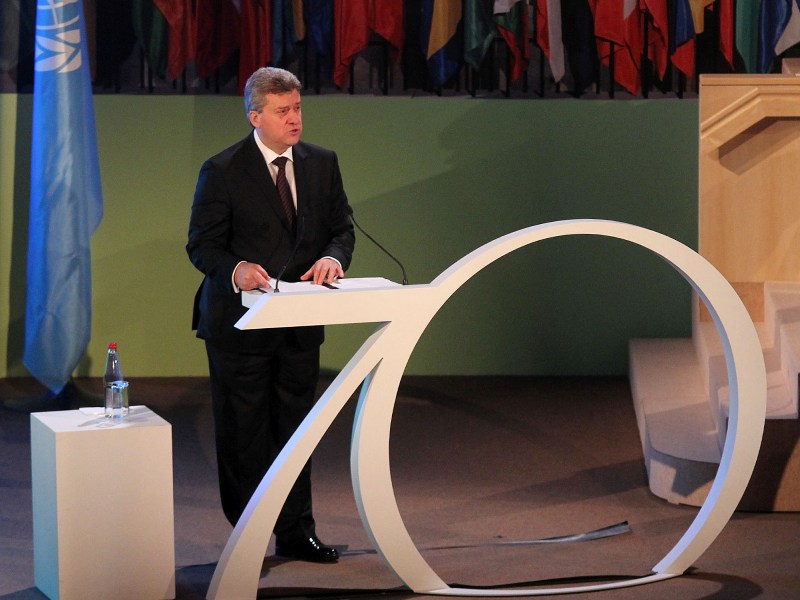
Address by the president Ivanov on the occasion of the 70th anniversary since the establishment of UNESCO
Monday, 16 November 2015 12:20


UNESKO_1Distinguished Director General of UNESCO, Mrs. Bokova,
Excellencies,
Ladies and Gentlemen,

As President of the Republic of Macedonia, it is my honor to speak at this historic event celebrating an important jubilee. I take this opportunity to once again convey the deepest condolences of Macedonian citizens to the citizens of France.

We must be sincere.
It is difficult to speak about education, science and culture whilst Paris is mourning.
It is hard to speak about cultural heritage and sustainable development when the tears of the families who lost their loved ones have not dried yet.
And yet, exactly beacause it is difficult and heard, we must speak about these things, since they are part of our response to the terrorists.

The grand narrative of human history is marked by the clash of builders and destroyers, of creators and annihilators, of artists and censors, of defenders and enemies of diversity, of those who transfer and those who forbid knowledge.

Today, in our era when global connectivity has reached unthinkable speed, volume and scope, we are all witnesses, but also participants in the clash between global civilization and global chaos, between order and disorder.

For 70 years now, the United Nations and UNESCO have been at the center of this clash. Two days ago, here in Paris, a new phase of that clash begun. Two days ago, here in Paris, it was not only the French Republic that was attacked – it was the entire civilized world. We shall not allow terrorists to take away our peace, freedom and justice.

Ladies and gentlemen,

There are many specialized agencies within the United Nations, dealing with issues related to the existential needs of humanity, such as food, water, environment... However, UNESCO has placed its focus on things that, one might say, are not bare necessities, but without which life would be difficult to bear.

Why? Because one of the fundamental features of human life is the profound need for meaning and belonging. And this feeling of belonging is not merely ethereal. Belonging is built through education that introduces us to the world, through the people we communicate with, the music we enjoy, the art we admire, the science that expands our horizons and everything else that defines our worldview. Cultural heritage helps us in our search for sense and belonging in this time of new world disorder.

By protecting cultural heritage, we simply admit that the world does not start, nor will it finish with us.

UNESKO_2Ladies and Gentlemen,

The Republic of Macedonia belongs to the cultural mosaic of humanity united in UNESCO. In UNESCO, we truly feel at home. Together we have achieved a lot. I wish to underline just a few examples.

We are protecting and promoting the natural and cultural treasures of the Ohrid Region. With its Neolithic settlements, ancient fortresses, early Christian basilicas, Byzantine frescoes and icons, and Ottoman heritage, the Ohrid Region is an overview of millenniums of living at a cultural crossroads in symbiosis with Nature.

In 2008, we opened the Regional Center for Digitalization of Cultural Heritage with a view of sharing the treasures of Southeast Europe with the world.

In 2013, the Institute of Earthquake Engineering and Engineering Seismology from Skopje became the only UNESCO Institute dedicated to the protection of cultural heritage against risks of major earthquakes.

We have celebrated many jubilees with UNESCO. We marked the 100th anniversary since the birth of the mother of the 20th century – Mother Theresa from Skopje. Together, we celebrated the 50th anniversary of the Struga Poetry Evenings, one of the oldest poetry festivals in the world, that has also been the home of many Nobel laureates.

However, UNESCO was also there for us in some difficult moments, like in 2009 when the monastery St. John Bigorski caught fire.

Together, we are fighting against illegal trafficking of cultural artefacts.

As a member of the Executive Board in the past four years, we have been consistent in our support to strengthen the international role of UNESCO.

The organization is dedicated to the education of youth, and education is provided through dialogue. The following year, in 2016, we will mark 1100 years since the passing of the All-Slavic educator, St. Clement of Ohrid. This will be an opportunity to revert to the roots of Slavic literacy. This Macedonian initiative was supported by Bulgaria, Poland and Russia. Together, we will promote the work of this great saint and teacher whose legacy has been enshrined in the Slavic languages spoken by 315 million people all over the world. One of his universal messages is that we should compete in kindness, because kindness is needed today more than ever before.

Dear participants,

11 centuries ago, the monastery St. Naum of Ohrid was built on the Ohrid Lake shores. For centuries, this Christian monastery has been a place where both Christians and Muslims praise God under one roof. And it is not the only one. In Macedonia, there is a multitude of such multi-religious temples which are an expression of the Macedonian model of co-existence, respect and acceptance of diversity. We see diversity not as a threat, but as a potential source for enriching our culture and identity.

Macedonia is not the only country with such heritage. The Balkans are an abundantly rich civilization corridor connecting the East and the West, the North and the South.

But, Ladies and Gentlemen, there is a serious danger that Macedonia might soon be one of the rare countries offering such an example.

Many spiritually and culturally rich regions are today in danger of being submerged in spiritual and cultural poverty.

Only three months ago, on August 21, 2015, ISIL destroyed such a monastery in Syria. St. Elian Monastery was not on the list of world cultural heritage and rare were the ones outside of Syria who knew about it. However, instead of a tourist attraction, this monastery was the thread that used to bring local Christians and Muslims together. Today, this and many other similar spiritual centers in the Middle East are only ruins. And by ruining these holy places, what is also ruined is co-existence among religions.

Cultural heritage is so much more than a tourist attraction. It is the foundation upon which the entire human civilization is built. Without that solid foundation, our new material and non-material works would be cast in quicksand and would inevitably sink into the oblivion of time.

In this global disorder, the irreversible destruction of heritage in the Middle East is equal to undermining the very foundations of our human civilization.

When the systematic destruction of entire communities, their homes and temples began in the Middle East, the world did not show lesser, but least resistance. We forgot that it is not only theirs, but our past as well.

We are now in the year 2015, establishing the agenda for sustainable development by reducing disaster risk and climate change. But, just like we have no alternative planet, we also have no alternative civilization or alternative past, for that matter. If we treat the past in such a way, then what kind of future might await us?

Throughout history, there have been builders and destroyers. And it is not the first time that destroyers have had their 5 minutes.
When, 70 years ago, we established the United Nations and UNESCO, we promised that we shall never again be passive spectators of evil. And yet, destroyers seem to fall through the cracks again.

Far be it to compate the value of buildings with human lives. But we must never forget that this heritage is part of humanity's cultural DNA.

UNESKO_3Ladies and Gentlemen,

Where did we go off the rails and how did we find ourselves lost in this labyrinth?
How did we allow for this violence directed against the present, but also past and future generations?

Led by the idea that "man is the measure of all things", we have made a wrong calculation. We entered the race for progress and breakthroughs, in parallel with the race for inequitable exploitation of resources; a race in which the only rule states that there are no rules.

We embraced progress, but at the same time we rejected tradition.

We became the carriers of a global pandemic of a virus known as homo consumericus.

We have tried to build and develop our modern civilization without ethics.

We became virtuosos of political correctness. We try to ease our conscience by claiming that we are tolerant, and forgetting that one tolerates what one must, but one respects and accepts what one loves.

We marginalized religion, forgetting that the majority of people in the world believe in the transcendental.

We separated freedoms and rights from duties and responsibilities.

Where did all of this bring us to?

In the past decades, many global and regional organizations were unfortunately seduced by the idea that religion is a passing fashion and thus decided to marginalize it. But not UNESCO.
Many organizations demonized religion as a reason for conflicts in the world. But not UNESCO.

UNESCO rightly understood that the reasons behind conflicts should not be sought in religion, but in the abuse of religion. For violence in the name of religion is violence against religion itself.

Ladies and Gentlemen,

Contrary to those who believed that the world is becoming increasingly secularized, we see that the world is increasingly de-secularized, without being homogenized.

And so, if the world is becoming more, rather than less religious, then the remedy for religious violence cannot be sought in less religion, but in more of interreligious dialogue.

UNESCO recognized this need on time. Therefore, when back in 2003 Macedonia initiated the first Forum of the Dialogue among Civilizations, this was realized in cooperation with UNESCO.

This forum of leaders of Southeast Europe helped us recall that, no matter how different we might be, we are nevertheless part of the common Balkan cultural space.

Regretfully, the Dialogue disappeared when most needed – when Europe is again relapsing into one of its old diseases – xenophobia. And not only Europe. Intolerance, exclusion and racism in the world have increased by manifold. Therefore, the need for dialogue has also significantly increased.

This is why we intend to renew the Dialogue among Civilizations in cooperation with UNESCO. We will also organize the Fourth World Conference on Inter-Religious and Inter-Civilizational Dialogue.

Same as previously, our efforts will be guided by the conviction that dialogue among different religions and worldviews ends where their diversity begins. The purpose of dialogue is not, and must not be, overcoming, but respecting and accepting diversity. This is the reason why we strongly support the work of the United Nations Alliance of Civilizations.

This is especially important today. And especially for Europe, where an entire river of refugees and migrants is headed, bearing their own ethnic, linguistic, religious and cultural diversity. The migrant and refugee crisis is at the same time an opportunity to learn again how to live with our deepest religious and cultural differences. Education, culture and science are vital to this endeavor.

UNESKO4Excellencies,

Someone might ask how all of this is related to sustainable development. It is indeed, and in so many ways.

In order to achieve sustainable development, we need a holistic approach that will encompass funding for development, disaster risk reduction and reaching a new climate agreement right here in Paris. But all of this is unfeasible without building a culture of sustainability. And culture is built through education. UNESCO's major project dedicated to youth, Education 2030, will have a decisive role to play.

The world needs UNESCO no more than ever before.
However, UNESCO is facing serious challenges.

The tragedy in the Middle East reminds us that development sustainability is difficult to achieve in conditions of global disorder. The tragedy in Paris reminded us of how much we, in Europe, are vulnerable to global disorder. This global disorder is the first challenge for UNESCO.

The lack of respect for international law made UNESCO a collateral damage of global disorder. And it is exactly this organization that should help us restore order.

The second challenge is lack of well deserved and necessary financial and political support. In conditions of economic crisis, the first to suffer are education, culture and science projects... Without them, we will only incite the negative cycle.

The world needs UNESCO today more than ever before. But, UNESCO needs our countries as well. The way to help is to keep the hands of realpolitik off the organization. We will help by providing the deserved financial support necessary to successfully finalize the successful reforms of the organization.

This year of celebration should be a wake – up call for all of us.

If not, then we will need decades to find our way out of the labyrinth we are lost in.

UNESCO is our hope to get back on the right track; To substitute exclusion with acceptance, xenophobia with respect and acceptance of diversity; To substitute monologue with dialogue of civilizations, and chronological snobbery with respect of the past.
All of this can be done with the help of UNESCO, the safeguard of humanity's cultural DNA.

Thank you.
UNESKO_5

CEII
Address by the President Ivanov at the CEI Diplomatic Forum
Wednesday, 11 November 2015 00:00

Distinguished participants,
Excellencies,
Ladies and Gentlemen,

As President of the Republic of Macedonia, it is my honor to address this diplomatic forum within the Macedonian chairmanship of the Central European Initiative – CEI. The honor is even greater since we see one of the oldest European initiatives attaching attention to one of the most important topics - regional cooperation in favor of youth.

We live in an era that is not even similar to any other before. In our fast – changing, hyper-connected world, today's date, November 11th is most famous by the discounts provided by the global stores named AliBaba and AliExpress.

Rare are those who will remember that the armistice that ended the First World War was signed on November 11th, 1918 at 11 am. The system undermined by World War I was later completely destroyed by World War II. Europe witnessed the rise of the Iron Curtain that served as a physical barrier between peoples for half a century. As a result of physical barriers, mental barriers appeared.

However, Europe was bothered by this unnatural wall. The Central European Initiative, chaired currently by the Republic of Macedonia, was one of the few autochthonous European reactions to this artificial division. Ever since its beginnings in 1989, the aim of CEI as well as of the European Union was to destroy the geopolitical and ideological barriers dividing the European continent.

Regional initiatives such as CEI played a key role in spreading democracy and reunification of Europe.

CEI3Benelux, the Vishegrad Group, the Nordic Council, the Baltic Council, which are still active today, have become an inspiration and motivation that drove the countries in our region to start the Southeast Europe Cooperation Process back in 1997.

But the Balkan itself was a forerunner of positive processes. In 2003, when our part of Europe was still a synonym for conflicts, divisions and isolation, we initiated the Forum of the Dialogue among Civilizations that was first held in Ohrid under the patronage of former President Trajkovski. Dialogue among civilizations became the predecessor of the United Nations Alliance of Civilizations.

And still, we cannot but notice that the situation is far from ideal. As for many other things, we can say that regional cooperation is in crisis.

There is a multitude of reasons for this.

The first serious challenges in the form of the global economic crisis and the current migrant and refugee crisis, were a test for regional initiatives. The European Union itself was not spared from taking this test, having in mind that as a peace project, it functions excellent in times of peace, but not as good in times of crisis. Although the Iron Curtain that used to divide Europe did not even stand for half a century, Europe on the other hand did not stand for 30 years without building new walls. The physical walls that we see now rising in Europe are based on mental barriers and walls, and these are the prejudice and fear of diversity.

Compared to its beginnings, the Southeast Europe Cooperation process has already started showing its weaknesses, except for its parliamentary dimension.

Regretfully, the Forum of the Dialogue among Civilizations disappeared when most needed – when Europe is again relapsing into one of its old diseases – xenophobia.

Even CEI, as the oldest regional initiative, seems to have begun losing its vitality and attractiveness.

What is all of this due to? It is difficult to give a unique answer.

Some regional initiatives failed to resist the temptation that almost all organizations face at some point, and that is, to become an aim in itself.

Other initiatives preserved their form, but lost the essence of regional cooperation, reducing it to declarations without actions and many good wishes without any serious intentions for their implementation.

Other initiatives that overestimated their capacities fell into the trap of hyperactivity and tried to cover all current topics. This unfortunately led to overlapping of competences, doubling costs and activities, without delivering the promised results.

As a result of all this, a serious vacuum space was created in the area of regional cooperation.

Dear participants,

In such complex circumstances, it is quite natural for states to focus on what is actually bringing results. Authorities increasingly shift their time, attention and dedication to the regional initiatives that, so to say, offer the best and highest quality services on the market.

While some of the older mechanisms faded out, new mechanisms are filling in the vacuum in terms of cooperation. Let me give you just two examples.

The first example is the result of an initiative from the region itself.

Unlike some older Member States of the Union who seem to have forgotten the region they belong to, Slovenia and Croatia demonstrated responsibility towards the region they naturally affiliate with. The initiated the Brdo – Brijuni Process which enabled us to substitute declarations with specific projects that provide visible results. It has enabled us to substitute formality with an informal, but sincere dialogue regarding all issues of importance to the countries from the region.

For the candidate countries for membership in the Union, Brdo - Brijuni became a voice for the voiceless since it managed to reinstall our region in the Brussels agenda. In the past two years, we have had three highly productive Summits with the participation of President Hollande, Chancellor Merkel and President Fischer.

Just recently, on behalf of all countries participating in the Brdo Brijuni Process, Slovenia and Croatia sent a letter to the President of the European Council, conveying the conclusions of the last Summit of the Process.
One of the conclusions was that the postponement of enlargement, combined with the economic crisis and global security challenges has made our region even more vulnerable to external destabilization factors. It stated that the enlargement process is not purely technical, but above all a political and strategic matter. They urged Mr. Tusk for a joint Summit of the Leaders of the Union and the Brdo Brijuni Process - one that would be fully dedicated to restarting the enlargement process.

CEI4The Process delivered a specific result in the form of a Summit of the European Union and the Western Balkans countries. Both Summits held in Berlin and Vienna, with participation of Prime Ministers and Ministers of Foreign Affairs, produced specific projects regarding the Adriatic – Ionic road and Munich – Istanbul railroad.

This was the first example of regional cooperation whereby initiatives come from within the region itself.

But, there is also a second example of regional cooperation whereby initiatives come from outside the region.

Today, 13 out of the 18 CEI Member States are part of the 16+1 initiative of the People's Republic of China for cooperation with the countries of Central and Eastern Europe. As a result of this cooperation, two major highways are being constructed in Macedonia only.

I call upon the CEI to show the same enthusiasm when it comes to completing European integration. It is time for this continent to wave a single flag - the flag of the European Union.

Ladies and Gentlemen,

It appears that as countries we are too small for the great challenges imposed by globalization, but at the same time we are too big for the everyday challenges of our citizens. This being the need for a carefree childhood for our children, career prospective for you as young people, and a calm old age for our senior citizens.

The answer to both types of challenges is to be sought for in regional cooperation that should help in finding common solutions.

Older regional initiatives justified their existence. CEI contributed to the unification and democratization of Central, Eastern and Southeast Europe. The Cooperation Process and the Dialogue among Civilizations relaxed tensions among the countries in the region that went through the turbulent Nineties.

It was proven that the best initiatives are those created and built by the region itself, instead of being imposed by remote centers of influence. However, it is 2015. The world has changed dramatically. It is time to adapt initiatives to the specific and real needs of the citizens of our regions.

Distinguished young diplomats,

I am aware that my speech today is not as diplomatic, but it is very sincere. My appeal to you today is to be the wake-up call for regional initiatives.

Do not fit in the form of organizations and initiatives, because you do not exist for them, but they exist for you, even though in the course of time some of them forgot their raison d'être.

Help them rediscover their reason of existence.
Help them in recognizing your real needs and the needs of young generations. This can only be achieved by fewer declarations and more specific initiatives and proposals based on reality.

You are the generation of new technologies, a generation enjoying the advantages of global connections. You are already living in a world that provides you access to an enormous volume of findings and information.

Introduce your idealism and perceptions in regional initiatives and organizations. Introduce that fresh view of the new reality we live in, free of the prejudice from the past.
CEI_1

Perhaps one of the solutions might be to have greater focus on the strengths of these initiatives. We have seen that everyone cannot achieve everything. But every organization can achieve something and thus contribute to regional cooperation and creating a positive climate for you, young people.

And in order to achieve that, these organizations and initiatives must be reformed, and opened even more towards the youth, making your voice heard.

As President, but also as a university professor, I hear the voice of the youth and I know that the entire region is facing brain drain. I fully understand the motive of young people to seek for a better life abroad. But it is far more important and braver for young people to reject the paradigms of old leadership and create such a better life in their own countries, instead of looking for it elsewhere.

In order to achieve this, you need to be in the organizations without becoming prisoners to organizational logic.

With this as my final thought, I wish you a successful conference.

Thank you.

bazilika_1
Обраќање по повод поставувањето на плочата во чест Св. Кирил и Методиј во базиликата на Санта Марија Маџоре во Рим
Monday, 02 November 2015 16:22
There are no translations available.

Почитувани присутни,

Едно камче понекогаш решава за правецот во кој ќе се движи лавината на нечија судбина. Во 868 година, на ова место, во оваа базлика на Санта Марија Маџоре, папата Адријан II ги освети словенските книги на светите Константин-Кирил и Методиј, по што се одржа првата богослужба на словенски јазик. Тоа е она камче што ја загарантира иднината на словенските народи во Европа.

Денес сум тука за да ја изразам благодарноста на македонските граѓани и на македонскиот народ кон сесловенските светители и просветители – Кирил и Методиј. Оваа плоча, што денес ја поставуваме е резултат на повеќегодишни напори и залагања, но и остварување на сонот на многу генерации Македонци.

Јазикот е душата на народот. Но, додека кажаното некогаш се заборава, пишаниот збор секогаш останува. Бидејќи, преку писмото, ние на автентичен начин им го пренесуваме на идните генерации она што сме го наследиле од нашите претци. А сме наследиле многу.

bazilika_2Се вели дека „верата доаѓа од слушањето, а слушањето доаѓа од словото," од изговорениот и пишаниот збор. Делото на светите Константин-Кирил и Методиј е вградено во секоја буква што ќе ја напишеме и во секој збор што ќе го изговориме. Токму јазикот и верата не одржале како народ и тогаш кога не сме имале наша сопствена држава, и тогаш кога сме биле поделени, покорени и прогонувани. Во такви тешки услови, македонскиот јазик била нашата единствена комплетна татковина. А меѓите на таа татковина ги поставија токму светите Кирил и Методиј.

Тие ни оставија и комуникациски код што поврзува не само генерации, туку и цели народи и држави. Без нив, денес ќе живеевме во поинаква, духовно, културно и цивилизациски сиромашна Европа. Без словенството, со сета негова креативност и иновативност, не ќе можеше да се зборува за Европа. Затоа, еден од големите синови на словенството, Карол Војтила, Папата Јован Павле II во 1980 година, во своето апостолско послание EGRIGAE VIRTULIS ги прогласи светите Кирил и Методиј за копокровители и патрони на Европа.

Дами и господа,

Народите без писменост неповратно исчезнале во историјата. Македонскиот е еден од народите кои опстанаа благодарение и на делото на светите Кирил и Методиј. Затоа, со оваа плоча ние ништо не присвојуваме, туку само ја изразуваме нашата искрена и длабока благодарност.

Но, благодарноста кон Св. Кирил и Методиј не се изразува само со оваа плоча. Благодарноста ја изразуваме користејќи го македонскиот јазик и неговото кирилично писмо за постигнување нови дострели во културата, уметноста и науката. Бидејќи, јазикот е најголемиот жив споменик кои ние сме должни да го чуваме и унапредуваме, за оваа и идните генерации.

Ви благодарам.
bazilika_3

brisel
„I require fully integration of Macedonia in the security system of EU and NATO - Address at Leader's meeting in Brussels, regarding the migration on the Western Balkans route
Sunday, 25 October 2015 20:20


samit2Excellencies,
Ladies and Gentlemen,

Mr. Juncker, thank you for inviting us as a region to be part of the solution to the migrant crisis. This crisis is affecting all parties. It equally concerns the countries of origin, the countries of transit and the countries of destination of the migrants.As President of the Republic of Macedonia, I will take this opportunity to speak about the challenges that my country and my region are facing.

These are not challenges only for the European Union, but for Europe as a continent. We suffer the consequences of the migrant crisis without enjoying the benefits from the membership in the Union.

Refugees reminded us of the key corridor between the Middle East and Europe.Had the Union integrated this region in time, today the Schengen borders would have been protected and the responsibility of the countries shared. Had we been part of the security system of the Union and NATO, and had we been granted access to all databases, then we would not have been taken aback by this crisis.

Instead, there is a serious danger for this Balkan corridor to become a labyrinth in which migrants and refugees will be stuck, but also the candidate countries for membership in the Union. Now both states and migrants are suffering the consequences of these errors.

According to the latest information we have, the corridor opened by refugees from Syria and Iraq is now also being used by economic migrqnts from Africa and Asia. Instead of seeing the number of migrants drop with he coming of winter, it keeps on increasing. Moreover, the portion of refugees from Syria and Iraq is reducing, and the portion of migrants from Asia and Africa is increasing. We can submit the statistics on this. As I said, the winter did not reduce the number of refugees, on the contrary! The number of refugees and migrants arriving at our southern border, the border between Macedonia and the EU (Schengen to be more precise) is breaking every record recently, with over 10 thousand people on some days. I had the possibility to witness this myself three days ago when I visited the crisis area and personally talked to the migrants.

We are thankful to Germany for not allowing the full closure of the Balkan migrant corridor. Madam Merkel was right to underline that the eventual closure of the corridor by Germany might lead to a collapse of societies and states in Central, Eastern and Southeast Europe. It helped us last until now.

On 19 August 2015 the Government of the Republic of Macedonia adopted a decision declaring a State of Crisis for a duration of 30 days at the southern and northern state border due to the mass illegal entry of foreign citizens from the territory of EU and NATO.

In the interest of the national security of the Republic of Macedonia, and in terms of the security threats and risks arising from illegal migration from the territory of EU and NATO, we give the following comments:

1. We need permanent exchange of information with the institutions of the EU and NATO, as well as EU member-states and the candidate countries.
Establishing a unified, standardized and integrated system of information, based on collecting biometric data of the migrants and refugees, among all of the states on the so called Balkan route, with the EU and Schengen member states.

2. Especially, concerning Greece, we need to establish cooperation and communication between Macedonian and Greek police and intelligence services of the threats facing the region. The draft declaration adopted by both Macedonia and Greece states that "immediate border-related confidence-building measures should be implemented between Greece and Macedonia". Instead, we would like to see full cooperation at all levels within the law enforcement and intelligence services between Greece and Macedonia. We have to establish joint operational and rapid intervention teams, as well as permanent liaison officers both in Skopje and in Athens.

3. Furthermore, full access to databases of EU agencies for all non-EU member Balkan states should be provided.

4. Next, deployment of EU forces in non-EU area in Balkan region to secure the land migrant corridor from the "source" territory to "end territory". If the EU has already established the MARE NOSTRUM operation in the non-EU area ofthe Meditteranean – Lybian territorial waters - than why shouldn't the EU forces be deployed in the Balkan area.

5. Regarding the "hotspot" approach, daily operational coordination is needed between all non-EU Balkan states and other EU countries involved in the "Hotspot" strategy.

6. Support for Turkey, according to the recently proposed Action Plan of the EU.

In the coming period, Macedonia will act to protect its national security. Any solution that involves housing migrants in non-EU Balkan states will not be sustainable, as these countries do not have capacity or resources to deal with the expected volume of migrants. State instability would be highly likely in such a case. Also, refugee camps cannot be established in the non-EU Balkan states. Refugees and migrants can be facilitated in the safe zones and in the initial reception centers, in order to offer safety, security and humanitarian assistance for them.

As for the promised EU assistance and solidarity, I have to state that so far, Macedonia has been left alone to deal with the crisis using its own resources (financial, technical and human). We are grateful for the announced financial and technical assistance, but we have not received anything substantial from the EU to date.

Without being misunderstood that I am taking advantage of this address, I wish to send the following message:The immediate integration of the Republic of Macedonia and the entire Balkans in the security system of the European Union and NATO is indispensable. Immediate integration in the Schengen and Frontex systems is indispensable. However, access to the Schengen and Frontex cannot be a substitute to membership in the Union.

What is necessary is a full integration of the region in the European Union, because European security cannot be complete without the Balkan states.

Thank you.
samit1

prm_rotator
We have to be on the „table“ when EU will decide about the Balkan migrant corridor - Address at the opening of the Crans Montana Forum
Friday, 16 October 2015 10:08


govor_kran_montanaDistinguished Attendees,
Esteemed Excellencies,
Ladies and Gentlemen,

The topic of this panel is "The Western Balkan Migrant Route as a New Road towards the West". I have to admit that the title of today's panel surprised me. Does it say a new route? Can we talk about the Balkans as a new route at all? Why do we indeed talk about the Western Balkans?

The Balkans has always been a main corridor connecting Europe with the Middle East and North Africa. For centuries the Roman roads Via Egnatia and Via Militaris have passed through the Balkans, which are known today as Corridor 8 and Corridor 10.

Roman legions from the West have walked along Via Egnatia to conquer the East. The road used by the Roman Empire to militarily conquer the East was the same road that the Christianity from the East used to spiritually conquer the Empire.

The second ancient road, Via Militaris, which was passed by many European conquerors and many conquerors of Europe, passes through the Vardar Valley. Therefore, Bismarck said that "those who control the valley of the River Vardar in Macedonia are the masters of the Balkans".

It seems that decision-makers in Brussels have missed the tutorials in history and geography. It is so soon that they have forgotten that the Balkans is the gate of Europe and that the gate is characterized by multi-ethnic, multi-religious and multi-lingual diversity? They have become hostages of rhetoric and terminology that is not based on history and geography. How can we otherwise explain the artificial division of the Balkans into Eastern and Western? How is it possible that today we talk about the Balkans as a new route to the West?

The answer lies in the human revolt against geography in the 20th century. Communication and economic corridors were cut by impassable political borders which are increasingly branching, thus separating the open space. As the time passes, the physical boundaries that cut the corridors create mental boundaries and walls. It is on the mental walls of the 20th century that the physical walls are founded today, that sprout throughout Europe as barriers for the migrants. It is walls built of prejudice, xenophobia and fear of diversity.

Ladies and Gentlemen,

Symbolically, the 21st century began with the 9/11 terrorist attacks. Today, there is a new movement of peoples fleeing the failed states in the Middle East and Africa. Refugees have become migrants and illegal migration and the related risks started coming in Europe.

The greatest confirmation that the European Union deserves the Nobel Peace Prize is in the migrants and refugees. They flee to Europe considering it an area of peace. But how Europe treats them?

We hear more often that people talk about cultural suicide of Europe. But if Europe does not share solidarity with the migrants, can we confirm death of morality and ethics in Europe?

We hear statements that multiculturalism in Europe is dead. But is there any alternative? Rather than united in diversity, will Europe be now united against diversity? Instead integration without assimilation, does Europe now prefer integration with assimilation? Has the time come to redefine the concept of integration? Will integration be understood as an ability of the different to live in harmony or we will continue to use integration to make the unalike become like us?

We hear statements that Muslim migrants from the Middle East are a threat to Christian Europe. But has Europe forgotten that Christianity owes precisely to the Middle East? If Apostle Paul had no vision in which the Macedonian called on him to come to Europe, could we talk about Christian Europe today at all? I will remind you of one more thing. Most of the Balkans has several centuries of experience of coexistence with Islam. Does that experience make us less Christians?

We hear statements that, among the migrants, extremists and foreign terrorist fighters are hiding. Paradoxically, one of the main transmitters of radicalism against Europe is the European xenophobia. If Europe opened its doors to the migrants, then it would refute the radicalized individuals. But, if Europe closes its doors to the migrants, then, in the eyes of the majority of innocent migrants, it confirms what the radicalized minority claims against it.
govor_kran_montana_2

Esteemed Excellencies,

Developments suggest that the migrant crisis will further complicate. The end of the civil war in Syria is not yet in sight. Rather, the conflict is further deepened and already resembles a war of each against all.

Migrants stand between the impoverished societies they are fleeing from and the gates of Europe which are slowly closing.

The Mediterranean has become a mass graveyard of migrants. Refugees taking refuge in Turkey, Lebanon and Jordan have become restless and mass leave the camps and head towards Greece, where the Schengen border is porous. In such conditions, Corridor 10 is the fastest, safest and least expensive transit route for the migrants.

Hence, the Balkans is not new, but old route with a new name. If once the name of the route was Via Egnatia or Via Militaris, today it is Via Migrantes. Unlike the past, today, due to ineffective policies, this corridor is interrupted by walls, defending the national borders and territorial sovereignty.

Distinguished Attendees,

The migrant crisis revealed the crisis of the European institutions. It turned out that the EU functions well in times of peace and prosperity, but not in times of crisis. In a crisis, the EU cannot make decisions and thus the crisis deepens.

The inefficient security and migration policy of the Union has contributed this humanitarian and social phenomenon to become a grave security challenge. Governments were forced overnight to become smugglers, transporting migrants through their territories.

The external borders of the EU and NATO are porous. The states in charge to protect these external borders failed. Member-states were left alone, and each of them implemented its own policy of dealing with the crisis. The integrated border management was replaced by erecting walls and use of armed forces. The Schengen system was practically suspended while the Dublin Regulation 3 is being amended. In a crisis, the EU has no mechanism to sanction the behavior of its member-state.

Borders are closed, ramps are down, raised walls have two negative effects. First, they tighten the bilateral relations between the states. Second, they put pressure on migrants who see all this as a gate that closes even faster.
govor_kran_montana_1

Ladies and Gentlemen,

How is the Republic of Macedonia dealing with the migrant crisis? Macedonia is the first country in Europe to declare a crisis situation due to the migrant crisis.

Since the beginning of this year, about 300,000 migrants have passed through the Republic of Macedonia. Only in the past 5 months, more than 120,300 have been registered. Daily, Macedonia is passed by 4,000 to 7,000 migrants. They are given water, food, fast and safe transportation.

Monthly, Macedonia spends over one million Euros of its budget for migrants and activates the Crisis Management System. We are still waiting the assistance from the Union to face the migrant crisis.

The migration crisis has reminded the European Union that the Balkans is a continuation of the Eastern-Mediterranean corridor. If the Union timely integrated this key corridor, the situation with the migrants would have been different.

If the corridor is divided by walls and barriers, it will turn into a dead end where both the states and the migrants will be stuck. Now, the states and the migrants suffer the consequences of the failure of the Union. In such circumstances, best function and profit the most problematic categories, such as organized crime groups and their networks.

The care of migrants in the Balkan countries which are not members of the Union is unsustainable, because these countries have neither the capacity nor the resources to cope with the incoming waves of migrants.

Esteemed Excellencies,

Refugees, migrants, are a political, economic, social, security, demographic and confessional challenge that Europe has yet to deliver a coherent collective response. The ongoing efforts of the Union to stop the migration not only did not work out, but further exacerbated the problem. FRONTEX and Mare Nostrum have encouraged the migrants that they will successfully reach their goal. A new approach is needed that would transfer the migrants from the initial to the final point. We monitor the implementation of the Hot Spot Strategy of the European Union, which, unfortunately, does not diminish the illegal migration. In the future, many critics will comment that this decision favors the selection of eligible and ineligible migrants.

It is obvious that there is no common EU policy on migrant crisis. We have to be on the table when this policy is created. A decision cannot be taken on the Balkan migration corridor without the participation of the countries through which this corridor passes, regardless of whether they are EU member-states or candidate-countries for membership. The Balkans is part of Europe; the European Union cannot speak on behalf of the entire Europe until it integrates the Balkans.

We are aware that the migrant crisis affects all countries - the countries of origin, the transit countries and the destination countries. It therefore requires a response that will include all parties. And that response should encompass not only the consequences but also the causes of the migrant crisis. Peace is needed in crisis regions. The best security policy on the European continent is a policy that would ensure prosperity, economic and democratic development in the immediate and wider European neighborhood.

Thank you.
govor_kran_montana_4

zeneva_montana1
The Western Balkan countries must be integrated in the security system of the EU - Address at the opening of the Crans Montana Forum
Thursday, 15 October 2015 11:26

Distinguished Attendees,
Esteemed Excellencies,
Ladies and Gentlemen,

We live in a world whose complexity and instability is increasing daily. In the years to come, we will have to get used to living in a state of permanent crisis.

It turned out that the Balkans, Caucasus and the Middle East make the Bermuda Triangle of Europe. The Union could resolve this problem with full integration of the Balkans and with a more courageous policy towards the Middle East and North Africa. Instead of being focused on the European Neighborhood Policy, the Eastern Partnership, the Euro-Mediterranean Union and the Barcelona Process, the Union showed indecision and allowed the neighborhood to become a zone of conflict, anarchy and backsliding.

The world and Europe are facing the threat of violent extremism and radicalization, as well as emergence of foreign terrorist fighters. The main source of terrorists is the Middle East, a region where global interests of the great powers collide. There, the situation is worrying.

The conflict in Syria began as a civil and turned into a religious regional war. Now, there is a serious threat the regional war to transcend the borders of the Middle East. Practically, the Syrian battlefield currently includes almost all the world's superpowers. Thus, almost every group is battling on two fronts.

At first glance, the situation resembles what Hobbes called the war of all against all - Bellum omnium contra omnes. There are paradoxical alliances such as the friend of my friend is my enemy.

The conflicts in the Middle East have provoked religious fanaticism and violent extremism. As a result, millions of people are fleeing the chaos of the failed states and impoverished societies in which there are no conditions for the rule of law and respect for the fundamental human rights and the right to human dignity. The refugees have become migrants, seeking peace and security in Europe.
zeneva_montana3

Ladies and Gentlemen,

Migrants have reminded the European Union that the Balkans is a key European corridor connecting Europe with the Middle East and North Africa. The migrant crisis that has sprout as a humanitarian and social phenomenon has now grown into a grave security challenge. The inefficient Security and Migration Policy of the Union contributes thereof.

What are the consequences of the inefficient policies?

The external borders of the European Union and NATO are not protected. The mechanisms for supervision and control of state borders failed. The bilateral relations between the states are disturbed. Solidarity is abandoned. In this muddy water, best cope the most problematic categories such as organized crime groups and their networks.
Prevention and management of illegal migration and the latent threat of transfer of foreign terrorist fighters in the migrant corridor are serious challenges to the state institutions.

Imagine, in time of migration crisis and European xenophobia, there was a recent attack in Ankara. But, where does it lead to?

Faced with serious threats of terrorism, violent extremism and radicalization, forms of organized crime and bureaucracy, Europe is faced with the dilemma of Hobbes: how to strike a balance between freedom and security, between human rights and security. How is Europe going to solve this squaring of the circle?

The global threat of violent extremism and foreign terrorist fighters cannot be solved by bureaucratic procedures, but by managing the threat on daily basis.

Tackling this crisis is possible only by fully integrating police and intelligence services across Europe. What is needed is development of a preventive mechanism in the fight against violent extremism and radicalism, foreign terrorist fighters and risks of illegal migration. Experience has shown that intelligence and special operations are the best weapons in today's security environment.

In this regard, different cooperation and communication between the entities of the national security systems of the states is necessary. Single and coordinated response to the threats is required, as well as development of a preventive mechanism in the fight against violent extremism, radicalism and foreign terrorist fighters. The Western Balkan countries must be integrated in the architecture of the security system of the Union, with unlimited access to all databases. Each country can contribute by sharing its experience.

The time when the European safety and security were protected only on the territory of Europe is gone now. Now Europe is protected in the Middle East, Caucasus and North Africa. The only long-term guarantee of peace and security in Europe is building peace and security in crisis regions which are located in the immediate and the wider European neighborhood.

Thank you.
zeneva_montana_2

 
Start < Prev 21 22 23 24 25 26 27 28 29 30 Next > End
Page 22 of 64