Speeches
Address by the President of the Republic of Macedonia, Dr. Gjorge Ivanov, on the first regional networking conference “Be a mentor, change a life”
Thursday, 06 June 2013 11:39

Dear guests,
Esteemed Excellencies,
Ladies and Gentlemen,

It is a great pleasure for me to welcome you today on this first regional conference for networking of mentoring networks. I would like to congratulate the organizers and look forward to have many successful events and projects.

Distinguished Guests,

If the genetic code is passed through bloodlines, then professional, valuable and ethical code are transmitted through mentoring.

Knowledge, experience and skills that we have acquired have a real sense only if we transfer them to the next generation. Being a mentor means to serve, to invest part of ourselves for generations to come. I believe that this is the real value of the Macedonian network of mentors.

But, the role of the mentor is not only to transmit knowledge, or just to explain it. The mentor should above all inspire, motivate and transform.

I know this from personal experience. As a university professor, I had the honor of being a mentor to many of my students. I know how noble feeling is to help and witness the professional and the life growth and development of the people that we mentor.

I can also tell you that as a mentor I learned a few things.

Above all, I know that it is always more noble to give than to receive. We should try to help those who need life and professional guidance. Through guidance, encouragement and stimulation, we should always be prepared to change someone's life for the better.

Plutarch says that the mind is not a vessel to be filled but a fire to be kindled. I believe that people need to learn how to think, not what to think. If you teach a man what to think, that leads to unproductive single-mindedness. But if you teach a man how to think, you have created man with a free, open mind. That, to me, is the purpose of the mentor - to help people to open their minds to think outside the box, to find new solutions to problems, being aware of previous experiences.

I believe that all the people who have ever had the opportunity to mentor will agree with the view that the feeling of accomplishment is indispensable when you see young people succeed. The desire of every good teacher is to be overtaken and surpassed by their students.

It has been said that "success does not come as a result of being 100% better than your competition, but rather to be 1% better in a hundred different ways." If we work instead of just dream, if we inspire rather than just lecture, if we participate rather than just to belong, then we will be an example for future generations, and we will offer well-balanced ethical and moral values.

Only with dedication, care and patience we will encourage young people to live in accordance with the best ethical values. Only in that way we will convey life and professional principles to them, and they include self-confidence, diligence, respect for different opinions, respecting the rules of the game and a well developed sense of responsibility. Only then we will build a virtuous young people that are essential in every sphere of social life -in economics and politics, education and science, culture and sport.

That's why I have founded the School for Young Leaders, where proven leaders from around the world share their knowledge and experiences with the most successful young people of every generation. The engagement of young leaders does not end with the school, but continues in Alumni Association - ISLAA, which through its mission leaves a mark.

Ladies and Gentlemen,

With mentor networking, countries in the region make another important step for further involvement and encouragement of young women with entrepreneurial spirit.

Although it is a young initiative, previous experience has shown that the Macedonian mentoring network builds a successful model of mentoring. Success is always greater if you share it with others. This is the essence of this regional networking. We should not only strive to build successful generations in the Republic of Macedonia, but to invest and to exchange experiences with all countries in the region.

Dear friends,

The future is in people that create physical, material and spiritual deeds. Future is in dedicated, creative and innovative individuals. But the present belongs to the responsible people, mentors. I invite you to help and encourage them, to direct and to inspire them, to facilitate their path to self-realization. It's the least we can do.

Thus, at the end, I wish many more successful conferences and networking, much more successful mentoring.

Thank you.

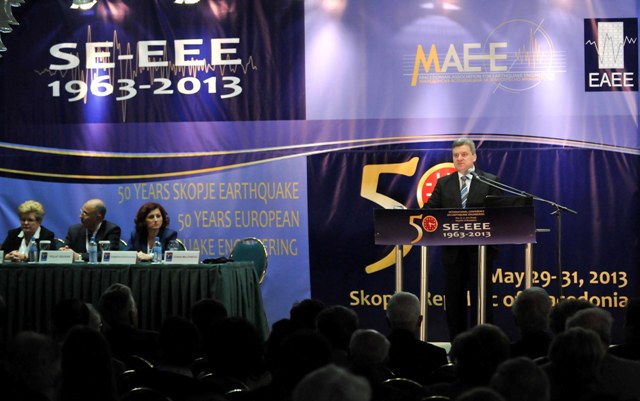
Address by the International Conference “50 Years of Skopje Earthquake – 50 Years of European Earthquake Engineering“
Wednesday, 29 May 2013 09:30

Distinguished Attendees,
Esteemed Excellencies,
Ladies and Gentlemen,

It gives me great pleasure to greet you in the Republic of Macedonia, in Skopje, the city of world solidarity. Let me extend my thankfulness to Professor Garevski and the team in IZIIS for organizing this important international conference, as well as for the invitation to be its patron.


Distinguished Attendees,

In a few weeks time we will be marking 50 years since the devastating earthquake in Skopje. Only few seconds were enough to destroy everything that was created in the city over the centuries. Only few seconds were enough to wipe entire settlements out, entire families to disappear, leaving behind a world of ruins. Skopje, being the capital of houses, overnight became the city of tents.

Friends in need are friends indeed. During the Cold War, the Skopje earthquake united the opposing sides. 87 countries, numerous international organizations, notably the United Nations, and thousands of humane people became engaged in the rebuilding of the destroyed city. Thanks to their unwavering support, Skopje, for the third time in its existence, rose as a phoenix. It was not just solidarity in words, but solidarity in action.


Ladies and Gentlemen,

Skopje earthquake posed a huge challenge to the world. The challenge can be summed up in one, still topical dilemma: are we able to build a secure future for our children.

You, the earthquake engineering experts, can provide part of the answer to this dilemma. Destroyed Skopje became ground zero in earthquake engineering throughout Europe. The great tragedy resulted in a new opportunity.

However, this year marks half a century of the European Earthquake Engineering, as an expression of human determination, determination to do everything in his capacity to prevent or at least reduce the devastating effects caused by the fury of nature.

You are a token of human striving for a safer world. I believe that love is the basis of it all. Love of life, love towards the closest ones, towards the legacy from our ancestors and heritage for the posterity.


Esteemed Excellencies,

I believe the second part of the answer to the dilemma is known to the decision makers.

In three days, in the city of UNESCO, Ohrid, I will be hosting the Summit of Heads of State and Government of the participating countries of the South-East Europe Cooperation Process. This will mark the completion of the year-long Macedonian Chairmanship with the oldest indigenous initiative in Southeast Europe. This conference we are opening today is also part of that process.
We will focus our talks with my colleagues, the presidents of the region, on what we, the leaders, can do to build communities, cities, nations and regions with a greater resistance to disaster risks.

Regardless of what kind of a decision is adopted at the Summit, one thing is clear. We cannot address it alone. We need the help of the scientific community. We need the expertise that you and your colleagues can provide on every risk the region of Southeast Europe is exposed to. Earthquakes, and fires, droughts and floods. Lives of 140 million people are at stake. Our citizens oblige us to that, our children are our future.

I am strongly convinced that the solution lies in building functional partnership between state and academia, between decision makers and experts in order to make smart decisions and adopt scientific-based policies. I will, therefore, propose concrete cooperation in this field.


Ladies and Gentlemen,

Only with your help we can create positive, scientifically grounded, applicable and long-term sustainable policies, policies that can be realistically implemented by the competent authorities of the States.

Our hosts today can serve as role model. IZIIS recently became a UNESCO Institute of category 2, the only such institute of UNESCO in the world that deals with earthquake engineering, seismology and major earthquakes risk reduction.

While the tragedy of the Skopje earthquake always saddens us, the international solidarity gives us hope, encourages and motivates us to easily overcome such challenges.

Today, our region needs solidarity in action. But this time, we must not wait for a disaster to happen. We must act preemptively. We can not simply afford the luxury of inaction.

As patron of this important international conference, I am confident it will help in finding the necessary practical and effective solutions to problems related to engineering seismology and earthquake engineering. At the very end, I wish you a successful conference.

Thank you.

Address by President Ivanov addresses the Gala Academy on the occasion of the Day of the University of Ss. Cyril and Methodius
Wednesday, 22 May 2013 22:01

Distinguished Attendees,
Ladies and Gentlemen,
Your Eminence,
Rector,

Today, we have gathered here to mark again the great work of the two Slavic apostles, teachers and monks. We have gathered to recall the historical and monumental mission of the Thessalonica brothers, Ss. Cyril and Methodius, the great educators and co-patrons of Europe.

1150 years ago, the reason for the Moravian mission of Ss. Cyril and Methodius was the letter of the Moravian Prince Rastislav to the Byzantine Emperor Michael III. The Prince, intending to make its state independent and strong, since it was threatened by foreign clergy, was aware that his nation needs a vernacular service, literacy and culture. Therefore, he sought for preachers who would spread the teachings of Christ in Slavic language.

The great scholar Constantine the Philosopher or the monk Cyril and his brother Methodius accepted this task by the Emperor, but the temptations were huge. How can this be done when there is no alphabet to translate the most needed books for worship? It was decided to take as basis the language of the Slavs from their neighborhood. Thus, in 855, they have created the first Slavic alphabet, the Glagolitic alphabet, which contains 38 letters. There are 24 letters in the Glagolitic alphabet taken from the Greek alphabet, and the other 14 from the voice system of the Slavic language.

In 863, the Brothers arrived in Moravia, along with their students, including St. Clement and St. Naum of Ohrid. They opened many schools and churches there that spread enlightenment in Slavic language and many new teachers were enlightened and started their work. The Latin-German clergy began to blame them for spreading heresy, and the Pope invited them to his court in Rome. On the way to Rome, Constantine, Methodius and their disciples spent some time in Pannonia, where they laid the foundation of the Slavic literacy in this country.

History says that before they arrived in Rome, they briefly stayed in Venice where Constantine, known as a good philosopher and orator, challenged the three language dogma or the dogma of those who advocated spreading of Christ's teaching only in Greek, Hebrew and Latin language.

Apart from the few preserved quotes, we do not know what Constantine the Philosopher said in defense of the right of every people to speak its language. But we can assume that, among the other things, he was inspired by what was written in the Acts of the Apostles to mark the feast of Pentecost in Jerusalem. That at Pentecost, every foreigner listened the apostles preach in their own native language. That the gathered foreigners in Jerusalem for the feast could hear the apostles talking about the great deeds of God in their own languages.
There is no clearer and voiced message than the one about the value of each language in the eyes of God. This, however, would make silent the three language dogma. Constantine successfully destroyed the accusations of heresy, saying that every nation has a right to its own language, believing in Christ.

In Rome in 869, Pope Hadrian accepted their explanation. He sanctified the Slavic books, meaning that the Roman Church officially recognized the Slavic literacy. It was a historic turning point in the European culture and civilization, because, at the same time, the diversity and the right of peoples to their own culture and identity were recognized. Shortly after the official recognition, Cyril became ill and died. The Basilica of San Clemente in Rome, where the remains of St. Cyril are buried, even today is a testament of the respect that the saints receive by the Slavic nations, European nations and the Macedonian people.

Following his death, Methodius continued the work, but he was repeatedly attacked and slandered by the German clergy and exhausted from fighting with them, from the imprisonment and persecution, he died in 885.

However, eleven centuries later, a great recognition for their work came on December 31st, 1980, when the Holy Father, Pope John Paul II, in his Apostolic Letter EGRIGAE VIRTULIS declared them as co-patrons of Europe.

We have to make parallel between Constantine the Philosopher and one of the pillars of the early church - Apostle Paul. Although there are 8 centuries between them, they are both citizens of the same empire - Roman or Romaean. Both are highly educated. Both are polyglots. Both are apostles. One of the first church, and the other of the Slavic. But despite these similarities, there is a vital connecting link - the desire to enable people to see and learn about the teachings of Christ in their own languages.

Our and all other peoples who enjoy today the benefits of their civilization mission, with pride and admiration, remember their deeds. Each generation builds on the knowledge, sentiments and rights of the people, left as a legacy by the previous generations. It refers, too, to the well-known students, St. Clement and St. Naum, standing on the shoulders of their teachers, they could see farther than others, and to bring to us, the Macedonians, those feelings and consciousness.

Distinguished attendees,

As old manuscripts say, the language in which Cyril and Methodius then translated the Bible, is the foundation of the Slavic languages. In this period, the period of translation of the Bible, certainly, their mission and outcome have no ethnic or national character. They have civilization role. Therefore, of today's ethnic prism or national perspective we cannot analyze the events and the civilization mission that took place 12 centuries ago.

What the holy brothers have done is one of the first examples of in-culturation or intercultural transfer. They shared knowledge, not imposing their culture on other nations. Colonialism imposes culture and cares not of other nations' culture. In today's world of democracy and human rights, in-culturation is particularly topical. The ideas of democracy and human rights are universal, but their implementation is always determined by the culture of every nation.

Today, we want to send from this gathering a very important, civilization, message. A call for respect of human rights. A call for respect of freedom and dignity of all people. A call for respect of the right to own identity. Respect of language, literacy and culture. Respect of the name which indicates identity

Centuries have passed since in this region the languages, in different empires, were respected, cherished and developed, regardless whether they were written in Glagolitic, Cyrillic, Latin or Greek alphabet.

Nowadays, it is not understandable that, in the region where the basis for all Slavic languages is taken from, it is not allowed the languages derived from that basis to be used. That it is not allowed these languages to be learned as native languages.

Indeed, the 2008 Report of the Special Representative of the Secretary-General of the United Nations for Human Rights, Ms. Gay Mac Dugal, determines this in the most distinguished way. Let me quote an excerpt:

"Successive governments have persisted to the policy of denial of the Macedonian community and the Macedonian language ... The answer to the former Greek governments was to suppress any usage of the Macedonian language and cultural activities. Lately, fierce tactics have stopped, but those who identify themselves as ethnic Macedonians still report discrimination and intimidation. They consider that the respect for their ethnic identity and diversity is crucial to their continued existence. The Macedonian language is not recognized, it is not studied and it is not used for teaching in schools".

Esteemed Excellencies,

I invite you, once again, to recall the words of the great scholar, Constantine the Philosopher, one of the greatest linguists, theologians and enlightened people of his time, St. Cyril:

"Does the rain fall from God to all of us equally? Or does the sun shine for all of us the same? Are we all not breathing the air equally? Aren't you ashamed to recognize only three languages, and to consider all other peoples and tribes blind and deaf? Do you think God is so helpless not to be able to provide for this, or that he is envious, not willing to do so?"

Because all people are equal before God, the languages people pray in is equally dear to God. And our language and our Holy Apostolic Church existed and will exist. It will exist and evolve, regardless whether certain narrow circles, being filled with hatred and fear of diversity, in some states recognize this reality or not.

Ladies and Gentlemen,

Even 1150 years after, these words warn and guide us. They teach and inspire us.

Macedonia protects and nurtures the work of the holy brothers. From medieval frescoes, by temples dedicated to them, to the name of our oldest university. Macedonia celebrates their civilization mission with freedom, with rights and with dignity and honor for each of its citizens. I urge you to take this message with you, in your friendly countries, near and far.

May we celebrate this holiday for many years!

Thank you.

megureligiskaKonferencija
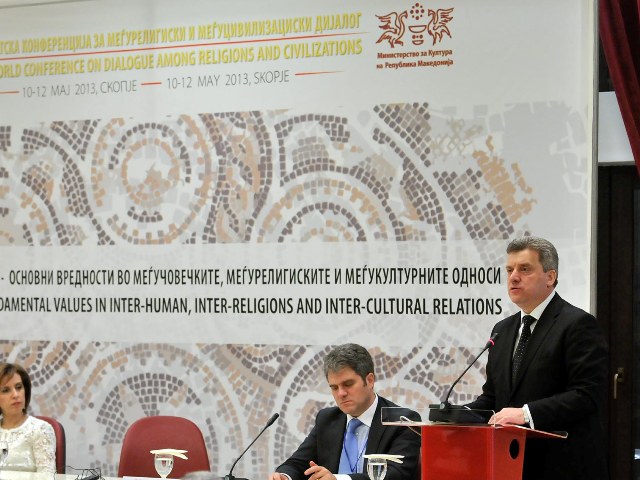
Address by President Ivanov at the closing of the 3rd World Conference on Inter-religious and Inter-civilization dialogue
Saturday, 11 May 2013 00:00

Address by the President of the Republic of Macedonia, His Excellency, Dr. Gjorge Ivanov at the closing of the 3rd World Conference on Inter-religious and Inter-civilization dialogue


Distinguished Participants,
Respected Excellences,
Ladies and Gentlemen,
Dear Friends,

It is my great pleasure and honour to greet you this evening in Skopje, the Republic of Macedonia, at the Third World Conference on Dialogue among Religions and Civilisations.

Today we are reaping the fruits of the seeds sown a decade ago. Seeds that were planted with the Ohrid Message on Peace and Dialogue among Civilisations initiated by President Boris Trajkovski.

Dear Participants,

It is said that, out of the abundance of the heart the mouth speaks, and our thoughts steer our words and actions. In the last decade of the 20th century, the Balkans were an argument used to support the thesis of clash among civilisations. Divisions, isolation and conflicts in this part of the world, unfortunately, were used as vivid illustrations of the alleged restlessness among civilisations and religions.

Ten years ago, significant change occurred in the hearts and minds of the people of our multi-ethnic and multi-religious region. If we talked about conflict in the recent past, today we are speaking of dialogue among civilisations and religions.

We also managed to complement the words with actions. In the past six years, by organising the three world conferences, Republic of Macedonia showed that it may sit various religions at the same table. Since actions stems from thought, I expect this dialogue will give birth to specific actions to the benefit of our children. However, cooperation, as well as dialogue, will not happen by itself. We have a lot more to do.

Respected participants,

This world may not develop without the foundation of the ethical and moral values embodied in the world religions. Values that lead to the great truth that people should treat the others the same way they would like themselves to be treated.

This is far from easy in a world where the binary paradigm still dominates: me against you; us against you; ours against yours. Separation, that is often source of alienation, exclusion and division among the nations. Separation incorporating the reason of fear, hatred and conflict among civilisations and religions.

It is well known that the basic dichotomy in most of the world religions is that of good and evil. The problem arises when man begins identifing evil with another man, with another nation, culture and civilisation.

St. Augustine says that "one should love the sinner, and hate the sin". I would add that one should love, respect and value man, irrespective of his origin, his ethno-cultural and religions identity. One should respect the human dignity of each individual. We must fight the distorted dichotomy of people's relations with the respect of diversity.

Macedonia has long-lasting tradition in this field. At the core of that is the experience of our multi-ethnic, multi-lingual and multi-religious society which has secured peaceful co-existence of religions. This tradition of coexistence and religious tolerance has created solid friendships between people of different religions. And as a result, Macedonia is one of the rare countries in Europe where Orthodox Christians and Muslims worship God under the same roof. These are places where religions not only meet, but also overlap in space and time.

Reminiscing of such deep Macedonian tradition, I feel discomfort that the representatives of the Islamic religious community is not participating at this conference for the first time. We should communicate. I have said and will say it again: one who communicates, also integrates.

I will give you another example. This evening we are in the Museum of the Macedonian Struggle. All official religions have been present here in the centre of Skopje. Orthodox Christians, and Catholic Christians, and Muslims, and Jews. In this microcosm of religious pluralism, the Mother of the 20th century was born, Mother Theresa. Here, in Skopje, she learned and lived the humanism, the tolerance and the dialogue. I believe that such environment, inspired her noble mission.

Ladies and Gentlemen,

23 centuries ago, Diogenes walked with the lamp in daytime, looking for the Man. We do not know whether the famous cynic managed to find the honest Man. However, we know that three centuries after Diogenes, through the parable of the good Samaritan, Jesus Christ gave the answer who is our fellowman.

Our fellowman does not have to be of our own ethnic group, nor speak the same language, nor have the same tradition as our own. It is above all, the merciful Man. Man who may conquer ethnic, religious and cultural differences and reach the one who needs help. Man capable to overcome prejudice in order to help the other, different and diverse.

The holy books of all world religions emphasize that all people and nations have the same origin, and should live together. Contemporary science affirms that. I believe, that this is sufficient for us to strive in our lives for peace, harmony and mutual understanding.

Today, we are truly searching for our fellowman. Hence, we have gathered at this Third World Conference on Dialogue among Religions and Civilisations. What drives us is not the lamp of Diogenes, but the desire to leave our children a better world. World, where human dignity will be respected. World where everyone will enjoy the freedom of religion, of confession.

All we are doing today leads in essence to the rule that we should love our neighbors as ourselves.

Dear Friends,

We may read different books, and we may go to different religious temples. We may have different perceptions and understanding of the nature of God. Be we all want dialogue, cohabitation and tolerance. We want our children to live in a world free of fear in uncertainty.

Our focus must be on the youth, who are our future. Therefore, upon my proposal, today for the first time within the Conference we organised the Youth Forum, dedicated to the role of religions in regards to the creation of tolerant young people. Youth for the Future and Future for the Youth is my motto, and at the same time is the focus of the 11th Forum of the Dialogue among Civilisations. Forum that will have its 10-year Anniversary gathering in Struga. I am convinced it is the only way to prepare them for living in our pluralistic societies.

Living together through respecting differences is a necessity. Irrespective of ethnic, confessional or linguistic affiliation, we must care for each other, for our homes, neighbourhoods, our towns and cities, the states and regions where we come from. Let us take care of our neighbour, and if he prospers, we too will have peace, well-being and prosperity.

With that invitation, at the end, I would like to thank you for your participation, dedication and contribution to the efforts for freedom, peace, development and human dignity.

Thank you.

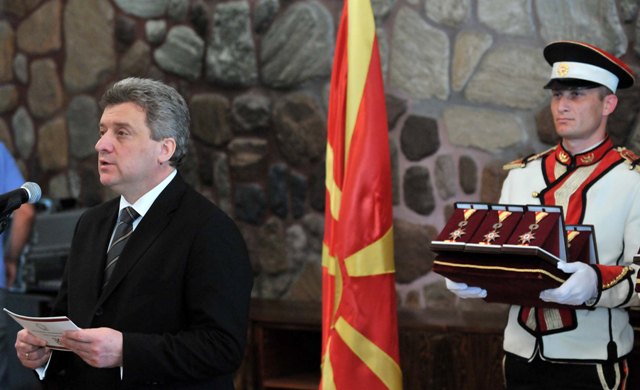
Posthumous Medal of Bravery to 32 members of the security forces of the Ministry of Interior
Tuesday, 07 May 2013 12:14

Respected members of the family of the deceased members of the Ministry of Interior,

Ladies and Gentlemen,

In the year when we celebrate the Day of the Macedonian Police, I have enacted a decree to posthumously award the Medal of Bravery to all members of the Ministry of Interior of the Republic of Macedonia, who courageously and sacrificially gave their lives for the homeland. With this act, I fulfill the promise I gave last year.

These are moments when we remember our heroes with deep sorrow. I know that we are not able to fully pay our tribute to the people who gave their lives for Macedonia. But we can and we must pay tribute to their great sacrifice.

Their lives were violently and prematurely terminated. Many desires remained unfulfilled, many important moments and many years unlived. Great pain remained that we all feel even today.

However, the completeness of a human life is not measured only in years spent in this world. It is measured by the deeds done, obligations met, the covenant left as an inheritance. The deeds of our heroes live in our memories and in the memories of their relatives and neighbors. All heroes who are decorated today met their highest commitment to their homeland. I believe they gave their lives thinking of their families, of the future generations, thinking of Macedonia. We are eternally grateful to them.

Ladies and Gentlemen,

A decade ago, fathers and mothers lost their children. Sons and daughters lost their fathers, who bravely gave their lives for Macedonia.

Lost child hurts the most. It hurts the most when a parent loses a child, a wife her husband and children their parents. It is very painful when we lose a close one, as we lose a part of ourselves. Our closest ones are part of us. Without them, there is a great emptiness in us and in our lives. Bodily wounds heal, but soul wounds never heal. These are open wounds that hurt us livelong.

As much as we want and no matter how hard we try, whatever we do, none of us can fully remove the pain from your hearts. None of us can make your sadness disappear completely. But we are here to help you, to comfort you and assure you that their sacrifice was not in vain.

Each deceased member of the security forces is a person with a name and surname. Man with his own view of the world and life. Each of them had his own story, his own dreams, his own plan for the future. They sacrificed all that for the homeland, defending the freedom, independence and sovereignty of Macedonia. They died defending the territorial integrity of our country - the Republic of Macedonia.

Therefore, today the homeland commemorates them all. Therefore, today we pay our tribute and recognition. Recognition for their courage and sacrifice. We award them the Medal of Bravery.

Dear family members,

In these moments of silence, when memories stem in the thoughts as tears stem in the eyes, I assure you that your pain is my pain. Your sorrow is my sorrow. I am aware that no words will change that. But I hope that today's act will give you comfort and make you proud.

Your loved ones did not give their lives in vain. Their sacrifice obliges us all to preserve and respect the constitutional order of the Republic of Macedonia. To stand for the values our ancestors fought for. To maintain the freedom, independence, territorial integrity and sovereignty of our homeland - the Republic of Macedonia.

Dear friends,

As President of the Republic of Macedonia, with these Medals of Bravery, I want to send a clear message: Macedonia will never allow her heroes to be neglected and forgotten! They will always live in our memories as brave sons who did what the homeland required of them in a turbulent period.

Today, when the Macedonian Police celebrates with dignity its day, with this act we are reminded of a traumatic chapter of the recent Macedonian history. I have said and will say it again: I urge this act to be understood as a symbol of a new and different chapter we have opened and we are fully committed to - to build Macedonia as a European country with European values, criteria and standards. Macedonia as a common, peaceful and prosperous home for all, regardless of ethnic, religious or any other affiliation or sense of belonging. Their sacrifice is the biggest investment to this future.

To the eternal glory of our fallen heroes!

Long live the Republic of Macedonia!

We build Macedonia together – Address at the Gala Dinner in the Cathedral “St. Clement of Ohrid” in Toronto
Sunday, 21 April 2013 09:07

Distinguished Attendees,
Esteemed Excellencies,
Ladies and Gentlemen,
Dear Friends,
Brothers and Sisters Macedonians,

Great is the pleasure to be here today in friendly Canada, among fellow countrymen and among our Canadian friends. I am here to convey heartfelt regards from our common homeland, the Republic of Macedonia.

At the same time, I would like to express my thankfulness to the organization "United Macedonians" for this recognition that bears the name of Metodija Andonov-Cento, known as the first President of independent Macedonia. I accept this recognition with pride and honor, not only on my behalf, but on behalf of the Republic of Macedonia and the Macedonian citizens, for everything that we do to protect, enhance and promote human rights respect.

This recognition is even more meaningful because we receive it in a year of important anniversaries related to human rights and freedoms.

This year marks the 65th anniversary since the adoption of the Universal Declaration of Human Rights, which begins with the statement that "the recognition of the inherent dignity and of the equal and inalienable rights of all members of the human family is the foundation of freedom, justice and peace in the world".

60 years ago, the European Convention on Human Rights was endorsed, which serves as inspiration for a number of human rights protection mechanisms worldwide. 15 years ago, in Strasbourg the European Court of Human Rights was established - the first international court where European citizens can seek protection of their rights against their own countries.

Distinguished Attendees,

No one should ever compromise when it comes to the basic human rights and dignity. Neither should we, the Macedonians. We are obliged to this not only by the international conventions and institutions, but also by the profound Macedonian tradition of coexistence, Macedonian commitment to tolerance and respect for diversity.

Tonight we are gathered in the temple dedicated to St. Clement, a great people's saint, educator and reformer of the 10th century, who has fought, through his activity, for the right of the people to speak, read and write in their own language. We can say that he and his teachers, Cyril and Methodius, are the initiators of what we call today the right to education in one's own language.

11 centuries later, in April 1941, in a time when the Macedonian nation did not have a state yet, and was faced with a policy of assimilation, exactly the right of own language was defended by Metodija Andonov-Cento with the following words: "Neither you nor any other can prevent us or our children, here or at home and in the classes, to speak our native Macedonian language, because we are Macedonians, and our children are Macedonian children. We, the Macedonians, have our own language and our children have the right to speak in their native language everywhere".

Dear Friends,

Each generation has its own struggle. The struggle of St. Clement was with illiteracy, ignorance and spiritual and intellectual blindness. The struggle, however, of Metodija Andonov-Cento was for a free, independent democratic Macedonian state.

Macedonians in the Republic of Macedonia and abroad have nowadays knowledge and literacy. We also have an independent Macedonian state. There is, however, spiritual unity of the Macedonians as part of a free Europe and a free world. I am particularly glad that friendly Canada is part of the free world in which the Macedonian community is respected and socially appreciated.

Ladies and Gentlemen,

Almost two millennia ago, as it is stated in the Bible, it is exactly through Macedonia that Christianity was spread in Europe. Today, we mark a golden anniversary - 50 years since the first Macedonian Church was established in Canada. A jubilee which is a confirmation that you, the members of the Macedonian Diaspora, have brought with you in Canada your values, beliefs and traditions as a contribution to this wonderful country that has become your second homeland.

Macedonia and Canada have many things in common. We share the same values. Both democracies apply similar model of integration without assimilation, a model that implies nurturing of cultural, ethnic and religious diversity. Our two countries promote tolerance and dialogue among citizens and among the peoples of the world.

Through their dedication and diligence, you contribute to the strengthening of the excellent bilateral relations between Macedonia and Canada. Binding the best of both cultures, the Macedonian community is the bridge that connects the two countries. I encourage you to further contribute to the welfare and prosperity of Canadian society. You are the ones that provide quality and content in the relations between the two countries. Remember that you are the image of Macedonia in Canada.

Dear Friends,

As President of the Republic of Macedonia, meeting expatriates wherever I go, I ascertain that among the countries in the world, Macedonia has friends, partners and supporters. But, above all, Macedonia has its Diaspora, which is an inseparable part of it, just as Macedonia is part of the life of the Diaspora.

I know that we share the same desires and visions for our common homeland, Macedonia. I call upon you all that we should be united under the motto: we shall live in Macedonia as we create it. And our wish is to have a more prosperous, more advanced, European and Euro-Atlantic Macedonia. Let us create Macedonia as a country open to foreign investment, advanced technologies, entrepreneurship and innovation. Country in which the economic growth, development and success are based on personal responsibility, professionalism and dedication. I urge that we should together build Macedonia in height, with the highest standards, criteria and values. We are obliged to this by our ancestors, but, above all, we are obliged by our children who are our future.

I reiterate, you are part of Macedonia. You live with the reality of Macedonia. It is the right to vote that enables you to do so.

Brothers and Sisters,

The doors of our common home, Macedonia, are always open to you. The bond between the homeland and the Diaspora is a value that has to be cherished. I am convinced that this relationship will be further maintained and strengthened.

Thank you.

 
Start < Prev 31 32 33 34 35 36 37 38 39 40 Next > End
Page 40 of 64