Speeches
The tendency of uni-polar Europe has ended, universal human values to be respected – address at the Eurasian Economic Summit on “Uni-polar or Multi-polar World?”
Thursday, 11 April 2013 14:07

Distinguished Attendees,
Esteemed Excellencies,
Ladies and Gentlemen,
Dear Friends,

It is a great pleasure to address you today at the Presidential Session of the 16th Eurasian Economic Summit. As always, our hosts have challenged us with a topical issue of global importance which is crucial for our shared Eurasian space.

Today, we are speaking about the uni-polar or multi-polar world. I do believe that it is always useful to understand first the essence of the concepts we make use of very often. What is the meaning of the concepts of uni-polarity and multi-polarity, what is their origin and where they lead to? What is, indeed, their nature?

Structural realists deem that division of power between states influences the attitude of the nations. In this regard, they distinguish 3 structures within the international system: uni-polar structure where one dominant state exercises power over other states, bi-polar structure where two states or two alliances of states are predominant, resembling the one of the time of the Cold War, and multi-polar structure consisted of several centers of power and influence, which is historically the most present and the longest lasting one. Most probably we should seek the cause for this in the tradition of the states and nations to endure. Indeed, Hugo Grotius in the 17th century said that "Liberty is the power that we have over ourselves".

Esteemed Excellencies,

The day today is symbolic. Exactly 3 centuries ago, on April 11, 1713, the Utrecht Agreement was signed and thus an end was put to the 13-year war for the Spanish legacy and the disturbed European principle of balance of power was re-established. 3 centuries ago, multi-polarity resettled the European scene.

The relative instability in balancing power through the "European Concept" resulted in the World War I. The tendency for uni-polar Europe, however, ended with the World War II and the cost for the humanity was millions of casualties. Two days ago, at the lecture that I delivered at the Istanbul University I said that the European Union was launched as a peace project aimed at prevention of new wars. As a response to the inefficient European concept and the fear of uni-polar Europe, the idea of Europe emerged as a peace project that would equally involve all its member states and nations.

Uni-polar and multi-polar discourse has always gravitated around the concept of super-power. We are aware that the European Union is facing numerous challenges. Yet, every challenge is an opportunity for new solutions. Today, the European Union and Europe in general is not military or economic super-power. Nevertheless, it is definitely life style super-power.

Ladies and Gentlemen,

There are lots of reasons that make multi-polarity dominant in the world history. But I will not take any of your time to discuss the most common ones in the context of the international relations. I will, however, briefly refer to the very nature of multi-polarity.

Universe is not uni-polar, universe is multi-polar. Based on the latest acknowledgments, it is consisted of countless galactic super-clusters which represent huge galactic groups. Our planet Earth is neither uni-polar. It has two geographical and two magnetic poles – north and south. Rotating around its axis, it determines the west and the east. In-between, on the map we recognize the north-east, south-east, north-west and south-west.

To sum up: there is no uni-polarity in nature, nor there is in the universe, in our planet. Counterparts exist. Polarity is everywhere around us: up-down, left-right, hot-cold, small-big, and we would add here good-bad. The battery in our cell phones has two poles – positive and negative. Uni-polarity we speak of today is man-made.

When we speak of uni-polar or multi-polar world, we often forget that basically it concerns human communities.

Aristotle said that the human being is a political being by its nature – zoon politicon. He went on to say that "the one who is unable to live in society, or has no need because he is sufficient for himself must be either a beast or a god". Self-sufficiency is a form of uni-polarity. However, this uni-polarity is apolitical, since there is politics, economy and exchange only in the community which is, according to its nature, multi-polar. There is not a single natural and lasting human community throughout the history that is uni-polar.

Distinguished Attendees,

There are differences among us. We all come from various parts of Euroasia. Our countries differ according to their geography, territory, demography and economy. They differ according to the systems, customs, cultures and traditions. But they are also different in their historical experiences. We are all different and still we have a compass that gives us clear direction where we should move.

The compass that I speak of is the international law. It would be very difficult for us to find our directions in our world if it would not be for that compass. Without compass there would be anarchy in the international relations. The rule of law and the human rights are fundamental principles one cannot compromise with. The international law provides for stability and order.

Distinguished attendes,

The physical compass functions exactly because of the bi-polarity of our planet. Imagine this world without compass. It sounds as a place difficult to live in. But can you imagine the world without poles or with only one dominant geo-magnetic pole? It would not be possible for the compass to function in such circumstances.

Man needs orientation. To orient himself in the space, man has the compass. In the darkness, the light. The states likewise need orientation. I said that the compass is the international law. The light represents the universal values and principles such as: freedom, human rights and human dignity.

Than, where did the idea for uni-polar world come from? Maybe from the human tendency to consider the current situation as permanent and unchangeable. However, it is constantly changing.

If we can say that multi-polarity is a rule, than it can be said that uni-polarity is an exception. And, as every exception, it occurs rarely and lasts shortly.

Therefore, I urge you all, let us not talk of world's uni-polarity but for an ambience in which universal and generally accepted human values, freedom, human rights, security and environmentally sustainable economic growth and development are respected. Let us strive to a world that respects the wealth of diversity. A world that would enable all of us to strive to higher and nobler objectives.

Thank you.

It is time for concrete cooperation in SEE – Address at the official opening of the 16th Eurasian Economic Summit in Istanbul
Wednesday, 10 April 2013 09:53

Distinguished Attendees,
Esteemed Excellencies,
Ladies and Gentlemen,
Dear Friends,

For already 4 years now I am honored to take part at the Eurasian Economic Summit. This summit is a place that brings together experience, wisdom and intellectual power of generations of European and Asian-Eurasian leaders.

As before, this year too, the Marmara Foundation gives us an excellent possibility to discuss topical issues related to the future of our Eurasian space. This year we are focused on the threats and opportunities for Eurasia, world's unipolarity or multipolarity, energy, information-communication technologies and security, education, health care and its effects on our nations, economies, on our relations in general.

Nelson Mandela said that a good leader can engage in debate frankly and thoroughly, knowing that, at the end, the two sides must be closer and, thus together, they will emerge stronger. I am convinced that these two days will be a great opportunity for genuine debate on the challenges and opportunities this generation is facing.

Esteemed Excellencies,

The word "crisis" in Chinese is consisted of two characters; one implies danger and the other opportunity. We live in a time of great and fundamental change, when the world economy situation is unclear. Change always brings opportunities. It is up to us to recognize and take advantage of the opportunities.

Last year I said that we need a new era of regional cooperation in South East Europe marked with concrete projects. Enough of declarative speeches and formalism. There is, however, among the great things that are suspected to be unachievable and the small things we often find excuses for, saying that we have no time to indulge in, a danger not to do anything. It is time for concrete cooperation for the sake of our citizens.

This year, the Republic of Macedonia presides with the oldest autochthonous regional initiative - the South-East European Cooperation Process. In June, I will be hosting a summit dedicated to specific issues, concrete problems faced by all our countries. We will discuss our specific contribution to increase the safety of our communities from natural and man-caused disasters. It will have a direct impact on the achievement of sustainable economic growth and development in terms of change in general. Change we can not always prevent, but we have to adapt to.

The credibility of our regional initiatives, of our regional gatherings is concerned. Citizens are looking for concrete work. The one, who is privileged to know, is obliged to do something, for this, but also for the future generations.

Tomorrow, at the Presidential Session, we will have the opportunity to exchange views on key topics like this one.

Dear Friends,

At the very end, convinced that this forum will ensure fruitful debate, exchange of views and opportunities for collaboration, let me, once again, greet all participants and extend my cordial congratulations to the organizers.

Thank you.

Address at the AmCham Conference “Exploring Opportunities to Advance Business – University Cooperation”
Thursday, 28 March 2013 11:54

Distinguished Attendees,
Esteemed Excellencies,
Ladies and Gentlemen,

It is my special pleasure to greet you today, at this Conference dedicated to the strengthening of cooperation between business community and universities. I would like to express my gratitude to the American Chamber of Commerce in Macedonia for the invitation and I also congratulate the organizers of this event.

The topic of this Conference is the everyday for many developed countries worldwide. Partnership between education, business and the state is generally accepted standard for achieving personal and collective success. But, for us, it is still a challenge.

Distinguished Attendees,

In the past period, Macedonia became known for the reforms. Everything that has been done so far, all investments in education, new technologies, opening up to foreign investment, changes in the areas of daily life, is a venture for young people. Investment in their present and future. Our common duty is to prepare them thereof.

The primary function of the universities is to educate people who will be competitive in the global labor market for their knowledge, skills and innovation. The primary function, however, of the companies is to contribute to the general success with their success. The state can and should be a facilitator and partner in creating conditions which would enable every student, every entrepreneur, every company to learn, develop and achieve its potential.

At a time when Macedonia opens up to the global market, it is necessary to return to the supply and demand model principles. Time has come when we need to reconsider the relationship between education and the real needs of business and society.

For our students and companies to be truly competitive we must fully overcome the situation in which supply does not correspond to the actual demand.

We have inherited conservative education system and a concept of student memorizing and professor concluding. Today, our higher education system should slowly but surely move towards the model of acquisition of applicable knowledge. The essence of the higher education is to offer knowledge acquisition method, and the programs offered should be aligned with the actual needs of the market and the society.

Ladies and Gentlemen,

As President, and as a university professor, I meet regularly the best students from the universities in Macedonia. I am aware that there is a real vacuum in our educational system. We lack practical teaching and applicative knowledge. The price is paid by young professionals, companies, and the Macedonian economy.

I have understanding for the business community, too. To expect the companies to carry out the work of the universities is the same as your company to play the role of family where your child grows. The company can not take care of your child, as it can not teach the employee those things he was supposed to learn during his studies. The primary role of the companies is not educational, as the fundamental role of the universities is not economy and production.

There has to be increase in the coverage of business in higher education programs. We have to increase the practical work in the curricula. We must pay greater attention to the development of skills that students will be able to practically apply. Professional and managerial skills need to be developed through opportunities for establishing companies by students during their studies. Such a positive example already exists. The Foundation "Youth Entrepreneurial Service", through the business incubator, supports the formation of micro, small and medium enterprises in the field of information and communication technologies, in collaboration with the Faculty of Information Science and Computer Engineering.

I encourage you, the businessmen, to meet university rectors and faculty deans that educate staff for your needs and exchange views on the curriculum. I encourage you to share your practical experiences with students, through the lectures that would be part of the curriculum.

Distinguished Attendees,

I am confident that we will be successful in filling the system vacuum. I will mention three positive examples.

As President of the Republic of Macedonia I have launched a project – the School for Young Leaders, which will be held for the fourth time this year. 115 young leaders with different academic and professional background have been trained by now at this School. The School helps them become familiar with the most advanced knowledge and experience of proven leaders from around the world. The project is supported by the business community in Macedonia, and thus it invests in future leaders. I take this opportunity to thank all the companies which helped realize this noble goal. I believe that what I, as President of the Republic of Macedonia, am trying to achieve with the future leaders is applicable in all higher education institutions.

As a positive example of the private sector, I want to emphasize the initiative of the Foundation "Trajce Mukaetov". Starting from the academic 2007/08, the Foundation has awarded scholarships for a total of 222 pharmacy and medicine students. Dozen of them have already started their careers in "Alkaloid" AD Skopje.

Yet another example of the private sector I would mention here is the successful model offered by the Mikrosam Academy, which is constantly investing in education of talented young people.

Indeed, I welcome all the initiatives of the private sector. I encourage all of you to follow these examples.

Dear Friends,

My motto is that we should create future for the youth, but also youth for the future. To enable them to compete with the products of their minds and their efforts. We must prepare them for the challenges of the 21st century. Future for the youth implies creating adequate conditions for their employment. Youth for the future are high-educated people who with their imagination, creativity and competence will be in step with the times.

We want economy based on knowledge, economy that will be built on the triple partnership between universities, private sector and the government. These three pillars do not exclude, but complement each other, and adjust to the needs. I believe that through the concept of this triple partnership we will succeed.

Thank you.

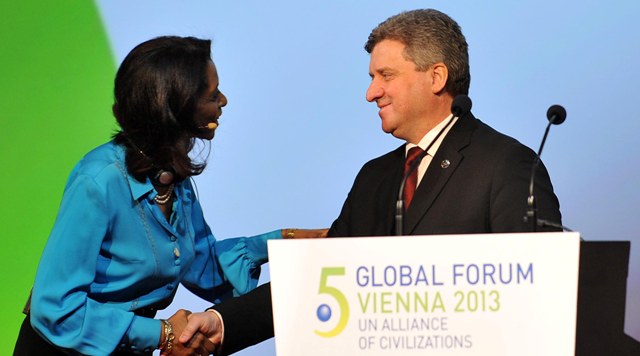
Address by the President Ivanov, at the 5th Global Forum of the Alliance of Civilizations, Vienna
Wednesday, 27 February 2013 11:52

Esteemed Excellencies,
Honorable Attendees,
Ladies and Gentlemen,
Dear Friends,

It gives me great honor to address the 5th Global Forum of the Alliance of Civilizations in Vienna. I avail myself of this opportunity to extend my thankfulness to our host, President Fisher, for the hospitality and I congratulate the organizers for this successful event.

Today's day is, in many aspects, symbolic. On February 27, Constantine the Great was born, the first Roman emperor who accepted and recognized Christianity, putting an end to the persecution faced by early Christians. On this day, in the year 380, Emperor Theodosius delivered the Edict of Thessalonica and thus Christianity became the state religion of the Roman Empire. By coincidence, this year marks 330 years since the Battle of Vienna. Today, the highest representatives of the two successor states are sitting at the same table and discussing the importance of the dialogue among civilizations. I believe there is no stronger message on the importance of dialogue. There is no clearer demonstration of leadership than what is happening today in Vienna.

Religions are changing in space and time. If in the past they were territorial, today, at a time of new technologies and Internet, religions are non-territorial. It is a challenge but also an opportunity to improve communication and dialogue.

Distinguished Guests,

Often I say that the one who communicates is integrated, and the one who does not communicate is ghettoized. Clash of civilizations is a result of lack of communication and dialogue. The Alliance of Civilizations is the right channel for communication and exchange of ideas that helps us overcome stereotypes and promote shared values of peace, tolerance and diversity.

"Anger and intolerance are the enemies of correct understanding", Mahatma Gandhi said. If each tree is recognized by its own fruits, then we need to seek the roots of many collective human tragedies of today in the intolerance, and there are, indeed, many such tragedies. Prejudice, exclusion, marginalization, hatred and intolerance towards diversity lead to tragedies.

Antithesis of religious intolerance is religious pluralism. Pluralism perceived not only as a greater diversity, but as perception and acceptance of such diversity. Religious pluralism is one segment of people's lifestyle, something that cannot be imposed, but is borne by the real life. "Tolerance is the consequence of humanity", Voltaire said. People are not born tolerant. Individual tolerance is a habit that is created and fostered during the entire lifetime. As far as the communities, peoples and nations are concerned, religious tolerance is a value that should be learned, built and upgraded for decades and centuries.

Ladies and Gentlemen,

Macedonia has a lot to say on this topic. Religious pluralism in our country is a result of the long period of existence of empires, which implies existence of different religious, ethnic and linguistic groups. Giving certain autonomy to the incorporated communities, the empires built complex non-territorial mechanisms of collective identities in the form of personal autonomies. This particularly refers to the millet system, which, at least in principle, prevented territorial demarcation and enabled a relatively peaceful coexistence of religions in the same space.

The Macedonian model of integration without assimilation emerges precisely from this imperial legacy. As a geographical and political entity, Macedonia has always been at the crossroads between East and West, North and South. Macedonia has lived in a world of diversity, respecting what is left as heritage. Macedonia has become one of the spiritual beacons of Christianity in Europe. Namely, in the Acts of the Apostles, 16:9, it is said: "And a vision appeared to Paul in the night; There stood a man of Macedonia, and prayed him, saying, Come over into Macedonia, and help us." And after he had seen the vision, immediately we endeavored to go into Macedonia, assuredly gathering that the Lord had called us for to preach the gospel unto them." It can be concluded thereof that Christianity was spread in Europe through Macedonia.

Since that time, life has taught us of coexistence, tolerance, mutual understanding and help, values that we practice even today. It is a positive example that should be valued, rewarded and should inspire others.

It reminds us of what we in the Balkans symbolically call Komshi-Kapicik. In the past, almost every house in Macedonia was separated from the neighboring house by a wall in which there was a small door - Kapicik. There were often such doors between two religions. It is known from those days, that even when the main gate between the neighbors was closed, the kapicik always remained open. Open for dialogue, exchange and assistance. The kapicik is a door that even in times of challenges was not supposed to be closed. Komshi-Kapicik is a traditional Macedonian and Balkan logic of inter-religious and inter-ethnic coexistence.

The basis of this logic is the experience of our multi-ethnic, multilingual and multi-religion society which, for centuries, has enabled peaceful coexistence among religions.

This tradition of coexistence and religious tolerance has created solid trans-generational friendships between people of different religions. And as a result, Macedonia is one of the rare countries in Europe where Orthodox Christians and Muslims worship God under the same roof. These are places where religions not only meet, but also overlap in space and time.

Macedonian religious pluralism can be confirmed by the mission of the mother of the 20th century, Mother Teresa, who was born in Skopje. In a radius less than 100 meters from her native house, there was a Catholic church, Orthodox church, a Jewish synagogue and a Muslim mosque. Mother Teresa spent her childhood in this microcosm of religious pluralism and has become synonym of a person living in religious openness and tolerance. Openness which certainly influenced her humanism she took with her to India, where she became the mother of the poor, needy and isolated.

The roots of this tradition are in the covenant left by St. Clement of Ohrid, the founder of the first Slavic University in Europe. He teaches us to compete in kindness, to have no enmity with anyone, to love each other without hypocritical love and to respect each another wholeheartedly.

Esteemed Attendees,

In some other countries and regions in Europe, relations between East and West, Christianity and Islam were marked by conflict, intolerance and isolation. There is, however, opposing dichotomy of peace, tolerance and integration in Macedonia.

We nurture our model within the country, with the Constitution and the political system, but we also promote it through the regional initiatives. Former President Trajkovski in 2003 initiated the first Forum of Dialogue among Civilizations, held in Ohrid. The Ohrid Declaration, echoes and is topical even today: "We, the participants in the Ohrid Regional Forum on the Dialogue among Civilizations, commit ourselves to a culture of dialogue, tolerance and peace in order to advance prosperity, well-being and mutual cooperation among the peoples and countries of the South-East Europe region". At the 10th anniversary of the Macedonian Initiative, I will have the honor to be the host of the 11th Forum of Dialogue among Civilizations. This initiative has given fantastic results for my region, at a time when the entire region was recuperating from a period of isolation, intolerance and conflict. The Republic of Macedonia launched, actually and formally, in 2003 regionally, what the Alliance of Civilizations intends to promote globally.

Convinced that dialogue is indispensable, in May this year, we will host the third World Conference on Dialogue among Religions and Civilizations, which is traditionally held in Ohrid. Macedonia has always believed and enforced in practice the view that the dialogue is indispensable, because it changes the hearts and minds of people.

Dear Friends,

More than a century ago, the father of the modern Macedonian state, Goce Delchev, said: "I understand the world as a field for cultural competition among nations". I believe it is time to expand the perception of the world as a field for dialogue among civilizations, which is the basis of cultural competition among nations.

Thank you.
berovo20
Address by the President Ivanov, at the reception hosted for the members of the Diplomatic Corps accredited to the Republic of Macedonia
Friday, 11 January 2013 21:20

Honorable Representatives of the Diplomatic Corps accredited to the Republic of Macedonia
Distinguished Excellencies,
Ladies and Gentlemen,
Dear Friends,

It is my pleasure to greet you all in the idyllic Berovo, and to wish you and your families much health, happiness and prosperity in the new 2013. I wish progress and welfare of the peoples and nations Macedonia maintains and develops close and friendly relations with.

Rest assured that I personally, and my associates, as well as the Macedonian state authorities, very highly appreciate your contribution to the promotion and development of the relations between Macedonia and your countries, not only political, trade and economic relations, but also cultural, scientific and educational, and, above all, human relations based on shared values and principles. Your contribution is, indeed, very important and I personally thank you for that. I encourage you to continue your commitment and dedication, in that direction and, hence, as before, you will enjoy our full support.

Distinguished Excellencies,

We are at the beginning of the new 2013, which is likely to abound with challenges and temptations at regional, European and global level.

Whether our countries are facing financial, social, ethnic, developmental challenges, we all, to a lesser or greater extent, feel jointly global problems. Increased disaster risks, consequences of climate change and unsustainable development, recession, violations of human rights and freedoms, as well as security threats are only part of the challenges of our interdependent world. Challenges that require common responses, concerted actions and coordinated policy. Macedonia stands ready, as always, to give its worthy and proportionate contribution in that regard.

At domestic level, this year Macedonia is to meet serious tasks which should provide welfare, respect of human rights and European and Euro-Atlantic future for the Macedonian citizens.

We remain committed to promoting economic growth, reducing unemployment and poverty. We are strongly committed to maintain the positive investment and reform cycle.

The year, unfortunately, has started with the renewed necessity for further strengthening of democratic institutions and practices in the country. I have always advocated for responsible approach when it comes to the interests of the citizens. I believe that with a dialogue within the institutions, every problem can be resolved. I am confident that we will find a way out of this situation, because a serious work is awaiting us all.

The upcoming local elections need to address the immediate and real needs and expectations of the citizens. Elections that should lead to further enhancement of the local government. Many of the municipalities in the Republic of Macedonia are multiethnic, multi-religious and multilingual, as is, indeed, the Macedonian multiethnic democracy. Therefore, this year we will continue to nurture and promote the quality of the interethnic and inter-religious coexistence in accordance with the principle of integration without assimilation.

berovo15Ladies and Gentlemen,

Internationally, regardless of our unfulfilled expectations in the past year, we remain firm on our determination to join the European Union and NATO. We remain committed to our policy of openness and cooperation to all and with all.

Neighborly relations and cooperation with the countries in the region remain our priority, particularly during the Macedonian Chairmanship of the South-East European Cooperation Process and the Forum of the Dialogue among Civilizations.

The Republic of Macedonia has always believed in and has applied in practice the view that the dialogue is indispensable, primarily for the good-neighborly relations, which are a two-way street. Macedonian society has no problem with any neighboring society. Politicians are obliged to follow our societies that are so much intertwined, economically and culturally, interpersonally and according to the shared values. They are obliged, through dialogue, to overcome the challenges and build a better today for our societies and a better tomorrow for our children.

I believe that with sincere mutual commitment and will, this year, we can significantly enhance and positively finalize the talks on the problem that our southern neighbor has with the name of our country, the Republic of Macedonia. In this regard, of crucial importance is the mediation of the United Nations Secretary General and Mediator Mr. Nimetz. But the support and assistance of your countries and the well-intentioned offers for mediation are very welcome. We remain committed to the process within the framework defined by the resolutions, the Interim Accord and the Judgment of the International Court of Justice. And, in this aspect, the correctness of our foreign policy is clearly confirmed, which is unconditionally based on respect of the international law, which would, otherwise, result today in the reign of the chaos and anarchy in the international relations.

berovo17

We are witnessing a paradigm shift in terms of the foreign policy worldwide. Credibility, constructiveness and sincerity in the cooperation today are replaced by the old worn-out diplomatic methods and practices, such as: outwitting, arrogance, hypocrisy and false friendships. The Republic of Macedonia will, in the future as well, continue to be a credible, constructive and honest actor in international community, by its unreserved application and practice of the international law and the highest universal values and achievements.

Dear Friends,

At the very end, let me make a toast for the new 2013, in the hope that it will make all our desires, expectations and positive ambitions come true. Let us make this toast, in the spirit of what was written by a famous German writer – “To everything we lack in our lives!” And, here, I would add: To everything that is always insufficient in our lives.

With this thought, at the very end, I wish you and your families much health, happiness and prosperity.

Thank you.

New Year’s address by President Ivanov to the citizens of the Republic of Macedonia
Monday, 31 December 2012 11:30

Distinguished citizens of the Republic of Macedonia,

In the moments when we are awaiting for the New Year, we are all united in the same wishes. Wishes for health, joy and happiness.

The year that is about to end was filled with a lot of expectations and a lot of challenges. These are times when the great ideas and big projects pass through periods of crisis. We are not immune to all that is happening in the world, both, in terms of economy and politics. You, respected citizens, feel those changes, but thanks to your wisdom and your strength, we always come out stronger and more decisive. Every crisis at the same time is a great challenge. Time for new possibilities and hopes. These festive moments, are moments when hope unites us all. Hope is what gives us the strength to endure on the common objectives. It gives us the enthusiasm and motivation for a better future.

These are the moments to remember that we should never underestimate what we have. To respect what we have obtained so far, both at home and among the closest ones, in the place where we live and work, but also in the country as a whole. Our responsible behavior gives us the right to request others to treat us responsibly. Differences and divisions must not distract us from the state interests and strategic goals. We need unity and togetherness, for a successful and prosperous Republic of Macedonia.

On this occasion, we owe our appreciation to all those who last year gave their contribution so that we can feel proud and successful. Each achieved result, every medal or recognition is a motif for new successes. The success of each of us is success of our country. What we invest is what we get and what we are recognized for.

Let me express my gratitude to the Army of the Republic of Macedonia and to the security forces that guard and defend our peace and our values.
 
Dear fellow citizens,
With optimism and strength, wisdom, dignity and honor may we step into the new 2013. It is the only way to achieve our goals. I believe that the Republic of Macedonia will take its deserved place. May we all together build Macedonia in height. Let us attain the highest standards and values.

Respected citizens,
With all my heart, on my behalf, and on behalf of my family, I wish your dreams come true. May you all have warmth in the home and joy in your children. Life has taught us to be patient, peaceful and compassionate. May you have a broad heart to give and receive love and kindness. Respect and help each other.

And we, the ones that have received your confidence, in the next year also, will continue selflessly to create a better and happier life for all of us. However, may the wishes be realistic in order to be attainable.
 
Happy New 2013!
May every one of us feel the justice, goodness, and beauty!

Dr. Gjorge Ivanov

 
Start < Prev 41 42 43 44 45 46 47 48 49 50 Next > End
Page 41 of 64