|

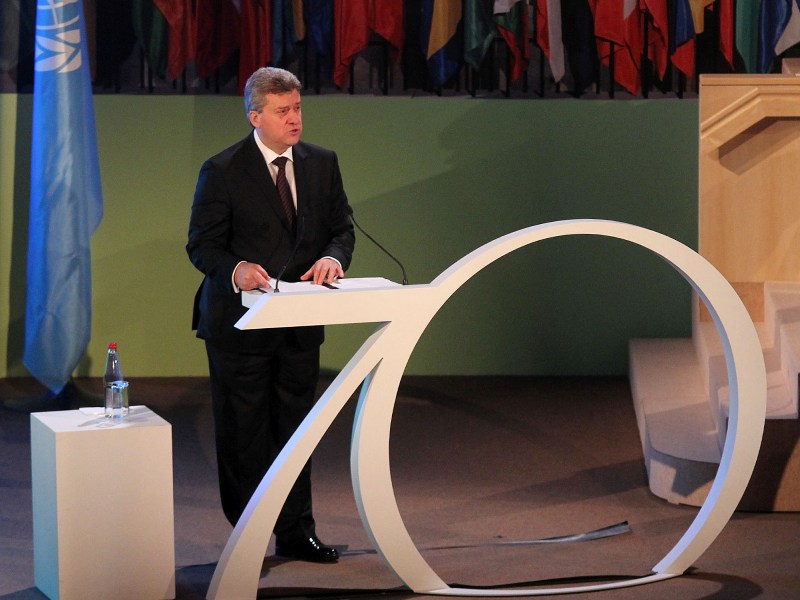 Distinguished Director General of UNESCO, Mrs. Bokova, Distinguished Director General of UNESCO, Mrs. Bokova,
Excellencies,
Ladies and Gentlemen,
As President of the Republic of Macedonia, it is my honor to speak at this historic event celebrating an important jubilee. I take this opportunity to once again convey the deepest condolences of Macedonian citizens to the citizens of France.
We must be sincere.
It is difficult to speak about education, science and culture whilst Paris is mourning.
It is hard to speak about cultural heritage and sustainable development when the tears of the families who lost their loved ones have not dried yet.
And yet, exactly beacause it is difficult and heard, we must speak about these things, since they are part of our response to the terrorists.
The grand narrative of human history is marked by the clash of builders and destroyers, of creators and annihilators, of artists and censors, of defenders and enemies of diversity, of those who transfer and those who forbid knowledge.
Today, in our era when global connectivity has reached unthinkable speed, volume and scope, we are all witnesses, but also participants in the clash between global civilization and global chaos, between order and disorder.
For 70 years now, the United Nations and UNESCO have been at the center of this clash. Two days ago, here in Paris, a new phase of that clash begun. Two days ago, here in Paris, it was not only the French Republic that was attacked – it was the entire civilized world. We shall not allow terrorists to take away our peace, freedom and justice.
Ladies and gentlemen,
There are many specialized agencies within the United Nations, dealing with issues related to the existential needs of humanity, such as food, water, environment... However, UNESCO has placed its focus on things that, one might say, are not bare necessities, but without which life would be difficult to bear.
Why? Because one of the fundamental features of human life is the profound need for meaning and belonging. And this feeling of belonging is not merely ethereal. Belonging is built through education that introduces us to the world, through the people we communicate with, the music we enjoy, the art we admire, the science that expands our horizons and everything else that defines our worldview. Cultural heritage helps us in our search for sense and belonging in this time of new world disorder.
By protecting cultural heritage, we simply admit that the world does not start, nor will it finish with us.
 Ladies and Gentlemen, Ladies and Gentlemen,
The Republic of Macedonia belongs to the cultural mosaic of humanity united in UNESCO. In UNESCO, we truly feel at home. Together we have achieved a lot. I wish to underline just a few examples.
We are protecting and promoting the natural and cultural treasures of the Ohrid Region. With its Neolithic settlements, ancient fortresses, early Christian basilicas, Byzantine frescoes and icons, and Ottoman heritage, the Ohrid Region is an overview of millenniums of living at a cultural crossroads in symbiosis with Nature.
In 2008, we opened the Regional Center for Digitalization of Cultural Heritage with a view of sharing the treasures of Southeast Europe with the world.
In 2013, the Institute of Earthquake Engineering and Engineering Seismology from Skopje became the only UNESCO Institute dedicated to the protection of cultural heritage against risks of major earthquakes.
We have celebrated many jubilees with UNESCO. We marked the 100th anniversary since the birth of the mother of the 20th century – Mother Theresa from Skopje. Together, we celebrated the 50th anniversary of the Struga Poetry Evenings, one of the oldest poetry festivals in the world, that has also been the home of many Nobel laureates.
However, UNESCO was also there for us in some difficult moments, like in 2009 when the monastery St. John Bigorski caught fire.
Together, we are fighting against illegal trafficking of cultural artefacts.
As a member of the Executive Board in the past four years, we have been consistent in our support to strengthen the international role of UNESCO.
The organization is dedicated to the education of youth, and education is provided through dialogue. The following year, in 2016, we will mark 1100 years since the passing of the All-Slavic educator, St. Clement of Ohrid. This will be an opportunity to revert to the roots of Slavic literacy. This Macedonian initiative was supported by Bulgaria, Poland and Russia. Together, we will promote the work of this great saint and teacher whose legacy has been enshrined in the Slavic languages spoken by 315 million people all over the world. One of his universal messages is that we should compete in kindness, because kindness is needed today more than ever before.
Dear participants,
11 centuries ago, the monastery St. Naum of Ohrid was built on the Ohrid Lake shores. For centuries, this Christian monastery has been a place where both Christians and Muslims praise God under one roof. And it is not the only one. In Macedonia, there is a multitude of such multi-religious temples which are an expression of the Macedonian model of co-existence, respect and acceptance of diversity. We see diversity not as a threat, but as a potential source for enriching our culture and identity.
Macedonia is not the only country with such heritage. The Balkans are an abundantly rich civilization corridor connecting the East and the West, the North and the South.
But, Ladies and Gentlemen, there is a serious danger that Macedonia might soon be one of the rare countries offering such an example.
Many spiritually and culturally rich regions are today in danger of being submerged in spiritual and cultural poverty.
Only three months ago, on August 21, 2015, ISIL destroyed such a monastery in Syria. St. Elian Monastery was not on the list of world cultural heritage and rare were the ones outside of Syria who knew about it. However, instead of a tourist attraction, this monastery was the thread that used to bring local Christians and Muslims together. Today, this and many other similar spiritual centers in the Middle East are only ruins. And by ruining these holy places, what is also ruined is co-existence among religions.
Cultural heritage is so much more than a tourist attraction. It is the foundation upon which the entire human civilization is built. Without that solid foundation, our new material and non-material works would be cast in quicksand and would inevitably sink into the oblivion of time.
In this global disorder, the irreversible destruction of heritage in the Middle East is equal to undermining the very foundations of our human civilization.
When the systematic destruction of entire communities, their homes and temples began in the Middle East, the world did not show lesser, but least resistance. We forgot that it is not only theirs, but our past as well.
We are now in the year 2015, establishing the agenda for sustainable development by reducing disaster risk and climate change. But, just like we have no alternative planet, we also have no alternative civilization or alternative past, for that matter. If we treat the past in such a way, then what kind of future might await us?
Throughout history, there have been builders and destroyers. And it is not the first time that destroyers have had their 5 minutes.
When, 70 years ago, we established the United Nations and UNESCO, we promised that we shall never again be passive spectators of evil. And yet, destroyers seem to fall through the cracks again.
Far be it to compate the value of buildings with human lives. But we must never forget that this heritage is part of humanity's cultural DNA.
 Ladies and Gentlemen, Ladies and Gentlemen,
Where did we go off the rails and how did we find ourselves lost in this labyrinth?
How did we allow for this violence directed against the present, but also past and future generations?
Led by the idea that "man is the measure of all things", we have made a wrong calculation. We entered the race for progress and breakthroughs, in parallel with the race for inequitable exploitation of resources; a race in which the only rule states that there are no rules.
We embraced progress, but at the same time we rejected tradition.
We became the carriers of a global pandemic of a virus known as homo consumericus.
We have tried to build and develop our modern civilization without ethics.
We became virtuosos of political correctness. We try to ease our conscience by claiming that we are tolerant, and forgetting that one tolerates what one must, but one respects and accepts what one loves.
We marginalized religion, forgetting that the majority of people in the world believe in the transcendental.
We separated freedoms and rights from duties and responsibilities.
Where did all of this bring us to?
In the past decades, many global and regional organizations were unfortunately seduced by the idea that religion is a passing fashion and thus decided to marginalize it. But not UNESCO.
Many organizations demonized religion as a reason for conflicts in the world. But not UNESCO.
UNESCO rightly understood that the reasons behind conflicts should not be sought in religion, but in the abuse of religion. For violence in the name of religion is violence against religion itself.
Ladies and Gentlemen,
Contrary to those who believed that the world is becoming increasingly secularized, we see that the world is increasingly de-secularized, without being homogenized.
And so, if the world is becoming more, rather than less religious, then the remedy for religious violence cannot be sought in less religion, but in more of interreligious dialogue.
UNESCO recognized this need on time. Therefore, when back in 2003 Macedonia initiated the first Forum of the Dialogue among Civilizations, this was realized in cooperation with UNESCO.
This forum of leaders of Southeast Europe helped us recall that, no matter how different we might be, we are nevertheless part of the common Balkan cultural space.
Regretfully, the Dialogue disappeared when most needed – when Europe is again relapsing into one of its old diseases – xenophobia. And not only Europe. Intolerance, exclusion and racism in the world have increased by manifold. Therefore, the need for dialogue has also significantly increased.
This is why we intend to renew the Dialogue among Civilizations in cooperation with UNESCO. We will also organize the Fourth World Conference on Inter-Religious and Inter-Civilizational Dialogue.
Same as previously, our efforts will be guided by the conviction that dialogue among different religions and worldviews ends where their diversity begins. The purpose of dialogue is not, and must not be, overcoming, but respecting and accepting diversity. This is the reason why we strongly support the work of the United Nations Alliance of Civilizations.
This is especially important today. And especially for Europe, where an entire river of refugees and migrants is headed, bearing their own ethnic, linguistic, religious and cultural diversity. The migrant and refugee crisis is at the same time an opportunity to learn again how to live with our deepest religious and cultural differences. Education, culture and science are vital to this endeavor.
 Excellencies, Excellencies,
Someone might ask how all of this is related to sustainable development. It is indeed, and in so many ways.
In order to achieve sustainable development, we need a holistic approach that will encompass funding for development, disaster risk reduction and reaching a new climate agreement right here in Paris. But all of this is unfeasible without building a culture of sustainability. And culture is built through education. UNESCO's major project dedicated to youth, Education 2030, will have a decisive role to play.
The world needs UNESCO no more than ever before.
However, UNESCO is facing serious challenges.
The tragedy in the Middle East reminds us that development sustainability is difficult to achieve in conditions of global disorder. The tragedy in Paris reminded us of how much we, in Europe, are vulnerable to global disorder. This global disorder is the first challenge for UNESCO.
The lack of respect for international law made UNESCO a collateral damage of global disorder. And it is exactly this organization that should help us restore order.
The second challenge is lack of well deserved and necessary financial and political support. In conditions of economic crisis, the first to suffer are education, culture and science projects... Without them, we will only incite the negative cycle.
The world needs UNESCO today more than ever before. But, UNESCO needs our countries as well. The way to help is to keep the hands of realpolitik off the organization. We will help by providing the deserved financial support necessary to successfully finalize the successful reforms of the organization.
This year of celebration should be a wake – up call for all of us.
If not, then we will need decades to find our way out of the labyrinth we are lost in.
UNESCO is our hope to get back on the right track; To substitute exclusion with acceptance, xenophobia with respect and acceptance of diversity; To substitute monologue with dialogue of civilizations, and chronological snobbery with respect of the past.
All of this can be done with the help of UNESCO, the safeguard of humanity's cultural DNA.
Thank you.

|


