|
 Distinguished Attendees, Distinguished Attendees,
Esteemed Excellencies,
Ladies and Gentlemen,
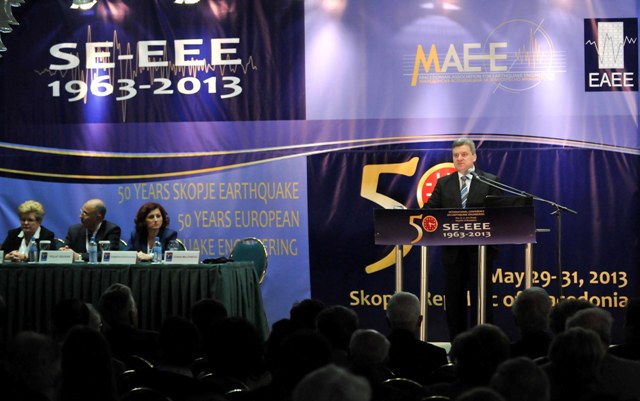
It gives me great pleasure to greet you in the Republic of Macedonia, in Skopje, the city of world solidarity. Let me extend my thankfulness to Professor Garevski and the team in IZIIS for organizing this important international conference, as well as for the invitation to be its patron.
Distinguished Attendees,
In a few weeks time we will be marking 50 years since the devastating earthquake in Skopje. Only few seconds were enough to destroy everything that was created in the city over the centuries. Only few seconds were enough to wipe entire settlements out, entire families to disappear, leaving behind a world of ruins. Skopje, being the capital of houses, overnight became the city of tents.
Friends in need are friends indeed. During the Cold War, the Skopje earthquake united the opposing sides. 87 countries, numerous international organizations, notably the United Nations, and thousands of humane people became engaged in the rebuilding of the destroyed city. Thanks to their unwavering support, Skopje, for the third time in its existence, rose as a phoenix. It was not just solidarity in words, but solidarity in action.
Ladies and Gentlemen,
Skopje earthquake posed a huge challenge to the world. The challenge can be summed up in one, still topical dilemma: are we able to build a secure future for our children.
You, the earthquake engineering experts, can provide part of the answer to this dilemma. Destroyed Skopje became ground zero in earthquake engineering throughout Europe. The great tragedy resulted in a new opportunity.
However, this year marks half a century of the European Earthquake Engineering, as an expression of human determination, determination to do everything in his capacity to prevent or at least reduce the devastating effects caused by the fury of nature.
You are a token of human striving for a safer world. I believe that love is the basis of it all. Love of life, love towards the closest ones, towards the legacy from our ancestors and heritage for the posterity.
Esteemed Excellencies,
I believe the second part of the answer to the dilemma is known to the decision makers.
In three days, in the city of UNESCO, Ohrid, I will be hosting the Summit of Heads of State and Government of the participating countries of the South-East Europe Cooperation Process. This will mark the completion of the year-long Macedonian Chairmanship with the oldest indigenous initiative in Southeast Europe. This conference we are opening today is also part of that process.
We will focus our talks with my colleagues, the presidents of the region, on what we, the leaders, can do to build communities, cities, nations and regions with a greater resistance to disaster risks.
Regardless of what kind of a decision is adopted at the Summit, one thing is clear. We cannot address it alone. We need the help of the scientific community. We need the expertise that you and your colleagues can provide on every risk the region of Southeast Europe is exposed to. Earthquakes, and fires, droughts and floods. Lives of 140 million people are at stake. Our citizens oblige us to that, our children are our future.
I am strongly convinced that the solution lies in building functional partnership between state and academia, between decision makers and experts in order to make smart decisions and adopt scientific-based policies. I will, therefore, propose concrete cooperation in this field.
Ladies and Gentlemen,
Only with your help we can create positive, scientifically grounded, applicable and long-term sustainable policies, policies that can be realistically implemented by the competent authorities of the States.
Our hosts today can serve as role model. IZIIS recently became a UNESCO Institute of category 2, the only such institute of UNESCO in the world that deals with earthquake engineering, seismology and major earthquakes risk reduction.
While the tragedy of the Skopje earthquake always saddens us, the international solidarity gives us hope, encourages and motivates us to easily overcome such challenges.
Today, our region needs solidarity in action. But this time, we must not wait for a disaster to happen. We must act preemptively. We can not simply afford the luxury of inaction.
As patron of this important international conference, I am confident it will help in finding the necessary practical and effective solutions to problems related to engineering seismology and earthquake engineering. At the very end, I wish you a successful conference.
Thank you.
|


